Table of contents:
How to Master SaaS Sales
If you’re new to SaaS sales, you’ve come to the right place! This guide is a crash course in selling SaaS, and it will get you off to a great start by covering the key points of how to sell software as a service – including ten tips to help you sell like a pro, and five ways to optimize your sales funnels. Let’s go!
What is Saas? What is SaaS Sales?
Before we can answer the question, “What is SaaS sales?,” let’s define what “SaaS” or “software as a service” actually are, and how these solutions benefit customers and the companies that provide them.
SaaS software is hosted, accessed, and used online. Its subscription-based business model means lower maintenance costs, better customization, and fewer tech-related headaches for customers – and recurring revenue for the companies that provide it.
Most companies are moving toward SaaS business models. Even in the B2C space, the days of buying a graphics, accounting, or word processing program on a CD-ROM, installing it locally, and using that version of the software for 5–10 years are firmly behind us. The key players in these industries have universally moved to subscription-based models.
With this, customers must buy a monthly or yearly subscription in order to keep using the software. While many customers aren’t initially thrilled with this recurring expense, the SaaS model ensures that they always have the latest and greatest features, top-notch security, fewer bugs, and better support.
SaaS sales reps selling software as a service have the same or similar KPIs to sales reps working in other industries. They’re responsible for closing new deals, upselling current customers, and preventing customers from churning. Because SaaS relies on a subscription-based business model, customer retention and the resulting recurring revenue are critical to succeeding in this industry. Check out this article for ten tips to improve customer retention.

How is SaaS Selling Different from Other Types of Sales?
Enterprise-level SaaS solutions are expensive, complicated, and often involve multiple stakeholders. A successful SaaS sales strategy usually involves many sales and marketing touchpoints, with marketing being responsible for maturing leads into qualified leads and sales eventually taking over to (hopefully) close the deal.
If you’re new to selling SaaS, you should probably expect a longer sales cycle than you’re used to. The more expensive the product, the longer the sales cycle. The average SaaS sales cycle is 84 days, with annual contract values under $5K averaging 40 days while annual contract values of $100K or more will take around five and a half months to close.
In order to succeed in SaaS sales, most new reps need to invest time and effort in their professional development. In this business, stellar pitching skills are crucial. These are complicated products and it’s essential to not only adequately demonstrate the product’s features while highlighting its benefits but to do it in a way that speaks to each client’s – or even each stakeholder’s – specific needs.
It’s also critical to know the product inside and out so that you can demonstrate the product effectively, troubleshoot with confidence if something goes wrong, and answer highly technical questions without hesitation.
The 3 Types of SaaS Sales Models
SaaS sales generally follow one of three models:
- Customer self-service is the most common sales model for high-volume products at lower price points. These products, which are mostly sold online directly to individuals or small teams, don’t require much sales support.
- Transactional sales is the most common business model among SaaS companies. It requires a sales team to sell over the phone and occasionally onsite. This business model targets small- to medium-sized business using a pipeline generated by the marketing department. These products are generally customizable to meet a variety of use cases, and thus, subscriptions range in price.
- Enterprise sales is a high-touch consultative sales model that sells high-priced software at low volumes, usually to large corporations with highly specialized needs. This model has the longest sales cycle and often involves marketing people and engineers in addition to sales reps. This is model that we’re mainly focusing on in this article.
10 Tips for How to Sell Software as a Service Like a Pro
Having some previous sales experience under your belt is an asset, and these ten industry-specific tips for how to sell software as a service will help you build on that experience and succeed in this unique landscape.
1. Make It Customer-Centric
A successful SaaS sales strategy is based on problem-solving. Take time to listen to your prospects and understand their pain points. Listening more and talking less improves your chances of collecting all the information you need for a successful pitch – and to ultimately close the deal.
The typically long SaaS sales cycle is a prime opportunity to build a relationship with the prospect and help them feel that you understand their challenges, can help solve their problems, and will be a strong partner and resource for them in the future.
2. Understand the Problem and Sell the Solution
This is where the pitch might be different from what you’re used to. To be successful at selling SaaS products, a one-size-fits-all pitch that mentions every product feature isn’t going to cut it. If a prospect has entered the sales funnel, it’s because they have problems they think you can solve.
It’s not their job to know what they want or need, but it’s your job to help them figure it out. Talking less and listening more is really going to be an asset here. Ask questions, listen to the answers, and then think about how your product can help the prospect solve their problems – and hopefully bring even more value to their business.
3. Master the Art of Demoing the Product
Notice that we’ve said “art”—not “science.” Demoing too much of the product, particularly features that aren’t relevant to the prospect, can cause information fatigue and nudge them toward a different solution because they doubt whether they’ll be able to successfully use your solution in all of its perceived complexity.
Mastering the art of the demo means specifically showcasing how your product could solve the prospect’s problems and make their life easier. Focus on value-based selling instead of feature-based selling. Scenario-based demos can be particularly effective in showing that you’ve listened and understood the prospect’s needs while giving specific examples of how they might use your product to address their unique set of needs.
Remember, this is a demo not a training course. Try to limit your demos to 15 benefit-and-value-focused minutes.
4. Invest Time in Creating Customer Personas
With the previous three points in mind, create as many customer personas as makes sense – and create new ones as you encounter them in the field. This will prevent you from scrambling to reinvent the wheel every time you’re meeting with a new prospect.
Each persona should include:
- Prospect attributes (e.g., company size, job function, title)
- Main problems/pain points
- Relevant product features (i.e., which product features best address the prospect’s needs)
- Value proposition (i.e., what benefits does your product offer relevant to the prospect’s needs)
Eventually, you can use this information to create a “sales playbook and library” that you can tweak over time to sell even more effectively while reducing the time you spend preparing for each sales meeting.
5. Create a Sales Playbook and Library
Once you’ve been selling SaaS for a while, you can create a sales playbook and library that will potentially shave hours off of your meeting prep time, so that you can focus on chasing new deals.
Here are some of the things you should consider including, customized and organized according to each persona:
- Email templates
- Call scripts/list of qualifying questions
- Pitch presentations
- Demo checklists
- Closing techniques
6. Offer a Free Trial—but Keep It Short
Statistically, most people who sign up for a free trial use the product for about three days. By shortening the trial period, you create a sense of urgency and users are more likely to give the product a thorough test drive. A shorter trial period can also shorten the sales cycle, which reduces customer acquisition costs.
A 14-day trial is most common among SaaS companies. It’s long enough for prospects to fully explore the product and its capabilities while short enough to effectively create FOMO when the trial period ends. For more complicated products or sales processes involving multiple stakeholders, a 30-day trial might be a better fit because it allows time for all stakeholders to try the product and discuss it internally.
This is another prime relationship-building opportunity. Keep in touch with the prospect or main stakeholder during the trial period so you can hear their immediate impressions and provide guidance if necessary. In the spirit of talking less and listening more, you might also glean useful insights into how they’re using the product and how likely they are to buy.
7. Focus on Pre-Paid Annual Subscriptions
Monthly subscriptions come with the benefit of recurring revenue, but they also come with the ongoing risk of lost revenue due to cancellations. Annual subscriptions requiring payment upfront can generate cash reserves that can be reinvested into the business while reducing the likelihood of cancellations.
Customers who pay upfront are more likely to stay with a company over the long haul – even after the initial subscription period ends. To sweeten the deal, offer a slight discount over the month-to-month subscription rate.
8. Cross-Sell and Upsell Like Your Job Depends on It
If you come from a sales background, cross-selling and upselling were probably part of your KPIs. These revenue streams are even more important when selling SaaS and they figure prominently into most SaaS sales strategies. This is because SaaS companies rely on annual recurring revenue to stay profitable, and getting existing customers to spend more is one of the easiest ways to give recurring revenue a boost.
Using a tiered subscription model can help improve your value proposition by scaling your features and services according to each customer’s needs. Again, understanding the customer’s needs and delivering a personalized pitch is key to successfully enticing customers to upgrade.
9. Close the Right Deals
The importance of closing the right deals may seem obvious, but it’s paramount in an industry that relies heavily on recurring revenue to stay in business. Selling to the wrong prospects all but guarantees that you won’t keep them as customers.
Even worse, the wrong customers won’t succeed with your product, resulting in increased support costs and possibly bad word of mouth. The SaaS sales process is lengthy and expensive, and it’s a sunk cost if the customer ends up churning. So, qualify your leads and be OK with saying “sayonara” to any prospect who jeopardizes your chances for mutual success.
10. Keep One Foot in the Door
Relationship-building is a cornerstone of any successful SaaS sales strategy. Therefore, it’s imperative to demonstrate your value by nurturing an ongoing connection that anticipates and reacts to your customers’ changing needs after you’ve made the sale. Just because the customer has exited the sales funnel and been handed off to client services, you’re still responsible for identifying opportunities to cross-sell and upsell.
In the first month post-sale, the customer is likely to have been handed off to client services and is getting up to speed and feeling confident in the software basics. This is a high-touch period, during which you should check in to demonstrate that you’re still involved with the account and care about the customer’s success, hopefully cementing your ongoing business relationship.
In months two and three under client services’ wing, the customer should feel confident in their ability to use the software while starting to use some of its more advanced features. This is often an opportune time to check in to see how they’re doing and to identify opportunities to cross-selling and upsell while reinforcing their confidence in your company’s ability to give them the features and guidance they need to succeed.
Top-notch customer support is critical to retaining customers in the competitive SaaS market. This article has some helpful tips for how to use SaaS customer journey maps to improve customer service.
Start your 14-day
free Plecto trial today.
Discover SaaS Sales Funnels
A few years after the thick of the pandemic catapulted the SaaS industry to new levels of growth, the industry is more competitive than ever. With such stiff competition, it’s surprising that many SaaS companies still underutilize their SaaS sales funnels – which can amount to significant lost revenue.
We’ll explore the different stages of the SaaS sales funnel (also known as the “SaaS conversion funnel”) and suggest five ways that you can optimize your software sales funnel to generate more revenue. If you’re new to SaaS sales, you might first want to read this article to learn ten tips for how to sell SaaS like a pro, or this article explaining the six stages of a typical SaaS customer journey.
What Are the Stages of the SaaS Sales Funnel?
As you become more deliberate in using your SaaS sales funnel to your advantage, it’s important to understand that the SaaS sales funnel is different from the typical sales funnel in other industries.
One of the key differences of the SaaS sales funnel versus those of other industries is that the customer’s first purchase occurs in the middle of the funnel. This is because SaaS companies rely on recurring revenue for the majority of their income. In SaaS sales, the bottom of the funnel, where the sale usually takes place, is replaced by “retention” with a focus on building each customer’s lifetime value.
With the industry’s unique software sales funnel in mind, we can say that prospects entering your SaaS sales funnel will generally move through some or all of these six stages:
Stage 1: Unaware (Top of Funnel)
Prospects at this stage of the software sales funnel have identified a need or pain point and are beginning to look into solutions. At this point, they haven’t heard of your solution.
Stage 2: Aware (Top of Funnel)
At this point, the prospect’s research has led them to your solution. The company’s website or social media presence is usually the first touchpoint in the SaaS customer journey. This is a crucial point in the software sales funnel because this is where prospects get their first impression of your solution.
Nine out of ten B2B buyers say that online content has a moderate to major impact on their purchasing decisions, so it’s critical that your marketing messaging is on point. In addition, it’s important to entice the prospect to share their contact information so that the sales team can follow up and (hopefully) move them through the funnel.
Stage 3: Lead (Middle of Funnel)
Now you’ve piqued the prospect’s curiosity and they’ve requested more information about your solution. They aren’t ready to buy, but they’ve provided some contact information and have officially entered the sales funnel.
It’s usually at this point that a sales rep will make initial contact to ascertain the prospect’s needs and attempt to convert them to a qualified lead. This is a pivotal point in the sales process because this is where the lead will progress to the next step in the sales funnel – or go cold and not progress further in the journey.

Stage 4: Qualified Lead (Middle of Funnel)
Prospects in this category generally fall into two subcategories: marketing-qualified leads (MQLs) or sales-qualified leads (SQLs). MQLs have engaged with the company beyond their original request for information – for example, they may be asking product-specific questions.
Prospects at this stage of the journey usually have a short list of possible solutions and are trying to identify their best option. In this stage of the journey, it’s crucial to position your product as the best fit for the prospect’s needs – this is where a personalized pitch along with relevant case studies and videos becomes invaluable.
If the sales team senses an intent to buy, the prospect becomes an SQL and the next step is usually a product demo. The demo is often the last step before the prospect makes a decision.
Stage 5: Ready-to-Convert or Converted (Middle of Funnel)
This is the finish line! At this point in the software sales funnel, marketing and sales have done their jobs and the prospect is ready to buy or has bought an initial subscription to your product. If your software isn’t a self-service solution, this is where you’d negotiate things like price and contract terms.
Stage 6: Customer (Bottom of Funnel)
Now the sales team has successfully moved the prospect through the SaaS sales funnel and converted them to a paying customer. Here, the focus shifts from customer acquisition to customer retention.
Your company’s success in the SaaS industry hinges on recurring revenue from subscriptions, cross-sells, and upsells – so the work is just beginning. For most SaaS companies, upsells and renewals account for 75–90% of revenue vs. just 5–30% from the original sales.
Check out this article to learn 5 effective SaaS customer retention strategies to help you hold on to the customers you have while increasing their lifetime value.
5 Ways to Optimize Your B2B Software Sales Funnel
A successful SaaS marketing funnel is one of your inbound sales team’s greatest assets! Building your company’s software sales funnel before it has a SaaS marketing funnel in place is putting the cart before the horse.
Before a prospect enters the sales funnel, they first encounter your company’s marketing content – usually its website or social media presence. Make it easy for prospects to find your website by optimizing it to appear in the search results for your company’s products and services, and solutions to the problems it addresses for your customers.
Your website content should demonstrate how your company has solved problems, eased pain points, and contributed to its customers’ success. As a general guideline, these are the types of content prospects should encounter at each stage of the SaaS marketing funnel, which should work in tandem with your SaaS sales funnel:
1. Make Your Company’s SaaS Marketing Funnel Work for You
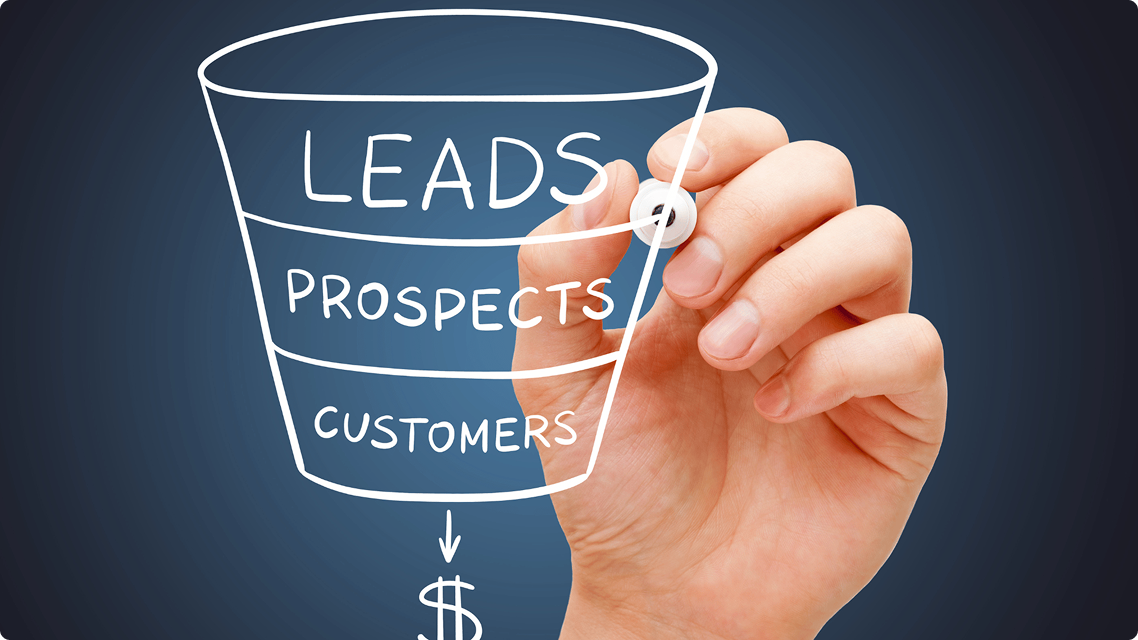
- Top of funnel – The first content a prospect encounters should position your company as an expert and the best solution provider to solve the issue at hand. Content at this stage should focus on the problem or pain point the prospect is looking to address, and how your solution can help. How-to guides, blog posts, and explainer videos have proven to be effective top-of-funnel communication vehicles.
- Middle of funnel – Case studies are particularly effective at this stage of the journey, along with solution-based demo videos (or better yet, interactive demos) showcasing specific product features based on the prospect’s specific needs. Price charts, testimonials, and customer reviews can also help in converting prospects who are ready to buy.
- Bottom of funnel – The communication focus during the retention phase of the SaaS sales funnel should be cross-sells, upsells, and continuing to demonstrate value for money to drive renewals. Communication here should highlight things like advanced product features and complementary products that can help increase customer lifetime value. Long-time customers who use multiple products are less likely to churn vs. new, single-product users or basic subscribers.
2. Create Content and Messaging Around Prospects’ Needs
It’s called a “customer journey” for a reason. Use segmented multi-channel messaging to reach the right prospects – and establish your company as a subject-matter expert.
Instead of solely pushing the type of content that sales and marketing would like customers to see, take a customer-centric approach and make sure that the majority of customer-facing content speaks to their needs at each stage of their decision-making process.
The most effective SaaS sales messaging is based on problem-solving. Create demos and pitches that speak directly to your prospects’ pain points, demonstrating that your company understands their challenges, can help solve their problems, and will be the right solution for them now and in the future. Prove that your solution is the prospect’s best option by showing them what you’ve accomplished for other customers with similar requirements.
3. Use Targeted Digital Advertising to Fill Your Funnel
Targeted digital advertising can provide outstanding ROI, and LinkedIn has proven to be an excellent way to reach B2B clients. Advanced analytics allow you to reach highly targeted prospects, which improves your chances of generating a qualified lead.
Campaigns targeting people who’ve already visited your company’s website are particularly effective, especially when combined with a strong content marketing strategy – 80% of B2B decision-makers prefer to get information from a series of articles vs. ads. A well-targeted ad and excellent content marketing material could be the magic bullet that gets your company onto a prospect’s short list of possible solutions!
4. Focus on Leads
This might seem obvious, but hear us out. The majority of your incoming sales leads are unqualified. Taking the time to qualify leads might seem like an arduous process, but it can save a lot of time and money in the long run because unqualified leads often don’t have purchasing authority and very often will never convert.
Many sales organizations make the mistake of casting a wide net instead of targeting the most valuable leads. This is inefficient.
Instead, identify the most valuable leads and nurture them by engaging, answering their questions, and moving them through the funnel. Your efforts will pay off – statistically, nurtured leads make 47% larger purchases than non-nurtured leads.
5. Measure Success and Failure Rates Throughout the SaaS Sales Funnel
68% of companies say that they don’t measure the effect of their sales funnels, so it’s hardly shocking that an estimated 79% of MQLs never convert. Figuring out where in your SaaS sales funnel prospects stall could be the key to closing more deals.
A high proportion of leads not converting to MQLs or SQLs could indicate that your marketing messaging is off relative to prospects’ needs or to what your product can actually do. Having a high number of qualified leads that don’t convert could be a clue that your pitch or demo could use some work – or maybe your case studies aren’t compelling enough. If you’re losing a lot of deals at the “ready to convert” stage, your negotiation skills, pricing structure, or contract terms might need some attention.
As a SaaS company, you have an extra step in your sales funnel. Don’t forget to track your recurring revenue, revenue from cross-selling and upselling, retention rate, and retention-related metrics like NPS, customer satisfaction score, and churn rate.
Become a SaaS Sales Pro with Plecto
Ready to take this newfound SaaS sales knowledge into action? We thought so!
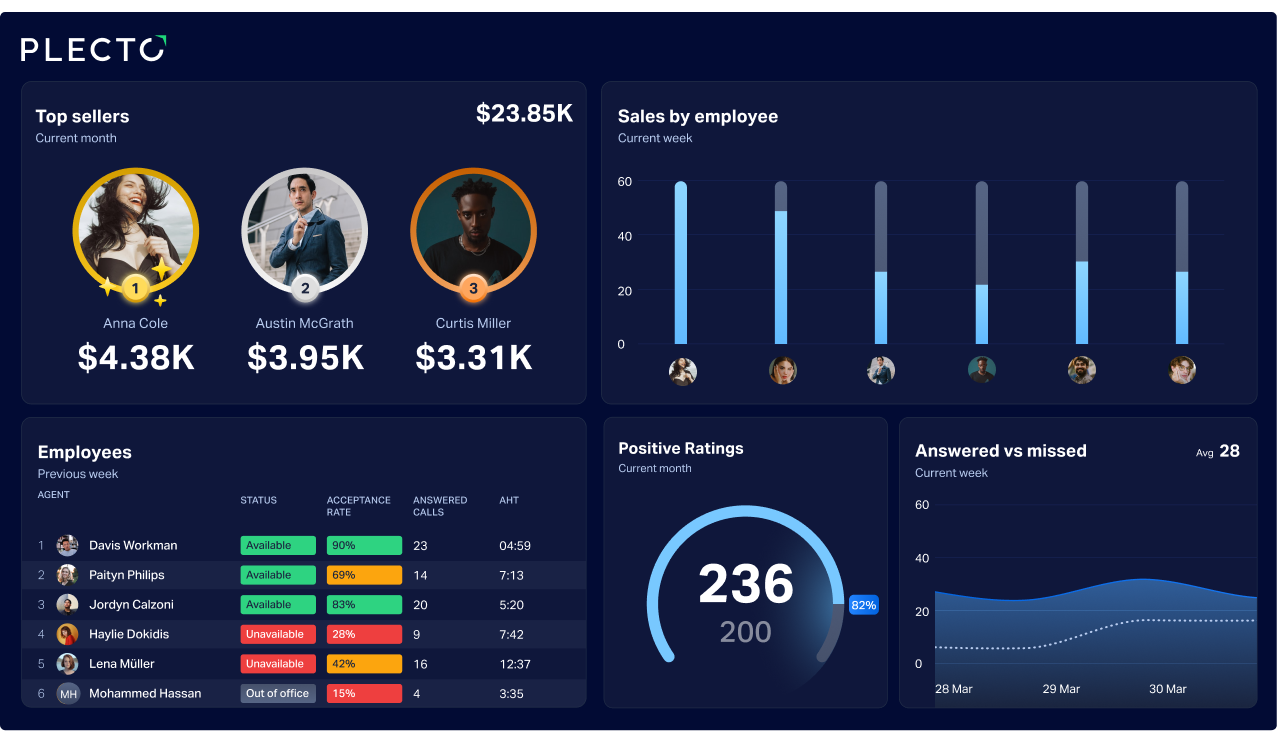
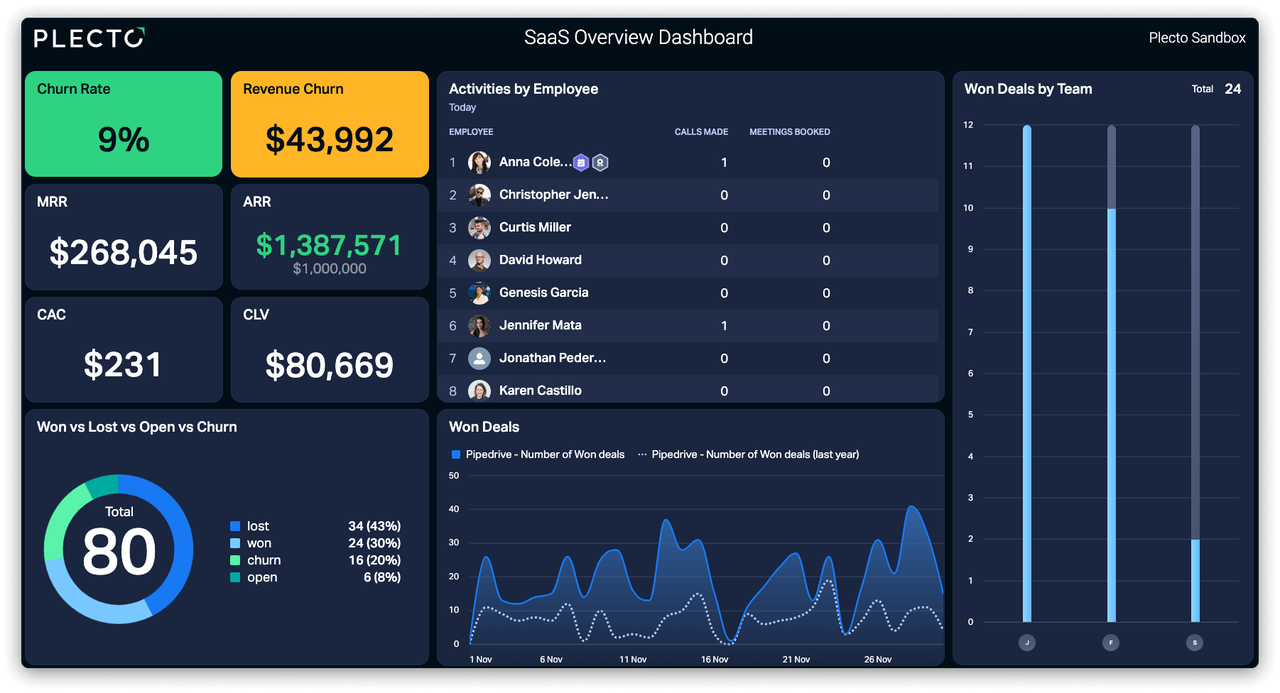
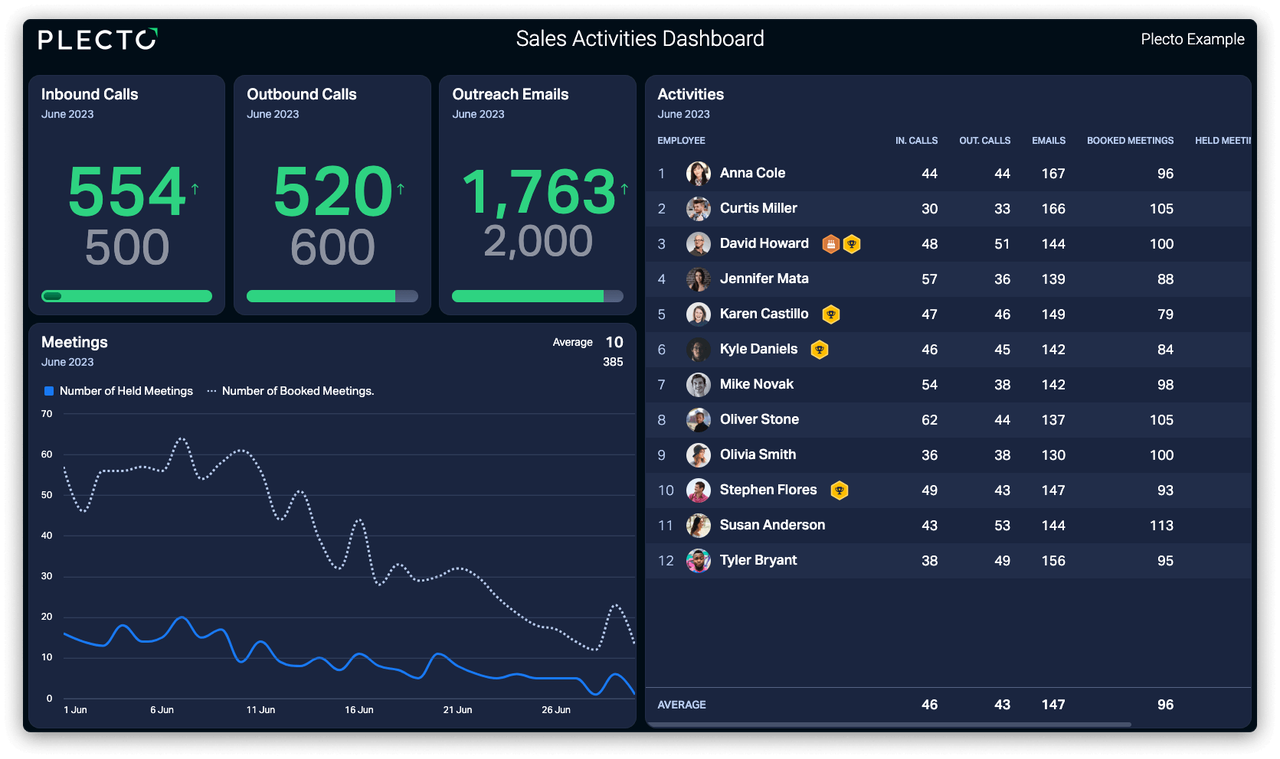
Plecto provides the perfect means to visualize your SaaS sales pipeline through our sales-themed Real-Time and Dynamic Dashboards. Don't wait—sign up for a free trial or demo, and start outperforming today!
Start your 14-day
free Plecto trial today.


SAGE CRAWFORD
Content Manager