
Run a Sales Gamification Pilot in 30 Days Before You Roll It Out to the Entire Team
Run a Sales Gamification Pilot in 30 Days Before You Roll It Out to the Entire Team
Sales gamification applies points, levels, badges, peer shoutouts, and leaderboards to make daily sales activity easier to see and engage with.
When done well, it helps reps see progress as it happens, stay aware of the behaviors that matter, and bring a healthy level of competition into the week without turning the workplace into a gimmick.
There is a reason it keeps showing up in sales teams. Visibility matters.
Harvard Business Review’s The Power Of Small Wins argues that one strong way to engage employees is to help them see progress, even in small steps. For sales teams, that matters because the week can feel like a blur of calls, follow-ups, notes, objections, and waiting. Broader research suggests gamification can produce positive effects, but only when the design fits the context, the users, and the work itself.
Before you roll anything out to the entire team, test it.
This article walks through how to run a 30-day sales gamification pilot, from choosing goals and tools to training reps, reading the results, and scaling what actually works.
Why You Should Run a Sales Gamification Pilot
A sales gamification pilot gives you a safe way to see how gamification behaves in your actual sales environment. It helps you answer practical questions before the stakes get too high.
What should you reward? Which behaviors matter most? How do you stop reps from chasing points instead of customers?
Having helped growth teams test new systems before they reach a wider rollout, Gregor Emmian, Deputy Chief Digital Growth Officer of Rise, often sees why pilots matter before leaders commit budget, process changes, and team attention at scale.
“The safest rollouts usually start small. A pilot gives you space to test the rules, watch how people respond, and catch the friction before it spreads across the whole team. When you treat it like a rehearsal, the full rollout becomes less risky and much easier to improve,” Emmian notes.
You can spot technical snags early, check metrics like meetings booked and pipeline created, and learn whether the language, rewards, and challenges feel natural. A full launch without that learning can create misaligned goals, clunky workflows, and rewards that push the wrong behavior.
That is why a small test matters. It gives managers evidence, reps a voice, and leadership a clearer reason to keep going, stop, or adjust.
Preparing Your 30-Day Sales Gamification Pilot
A strong pilot really starts before the first point is scored. Early decisions shape whether the program feels useful or like another tracker.
Below are the 3 setup areas to get right before launch:
Setting Clear Objectives
Prioritize the sales outcome that matters most in the next 30 days. Do not spread attention thin.
Name 1 to 3 measurable goals that support your sales strategy:
-
Book 15% more qualified meetings per rep
-
Lift opportunity-to-demo conversion rate by 5 percentage points
-
Move CRM data completeness to 95% across active deals
That specificity helps everyone understand the game. It also keeps managers honest. If Q3 depends on outbound pipeline, reward quality top-of-funnel activity. Do not overload the system with points for closed revenue if the real bottleneck is earlier in the funnel.
This is where good design aligns individual behavior with company goals without turning the team into robots. Reps still need judgment, but the scoreboard should point attention toward the behaviors the business actually needs.
Choosing the Right Participants
Aim for a pilot group that looks like your broader team. Include different tenures, territories, and performance levels so the feedback is useful.
Keep the pilot group at 8 to 15 people so patterns can surface.
Letting top performers dominate can give you a polished result that fails later at scale. Bring in reliable middle performers and a few reps who are still finding rhythm. Their responses show whether the system helps the wider team or just celebrates people already winning.
This matters in varied sales environments, including teams selling software, services, logistics, or wholesale apparel, where activity quality can look different by territory or account type.
Selecting Gamification Tools
Choose mechanics that fit your goals. Points can work for high-value activities. Badges can mark milestones. Leaderboards can create energy. Peer shoutouts can make effort visible before revenue arrives.
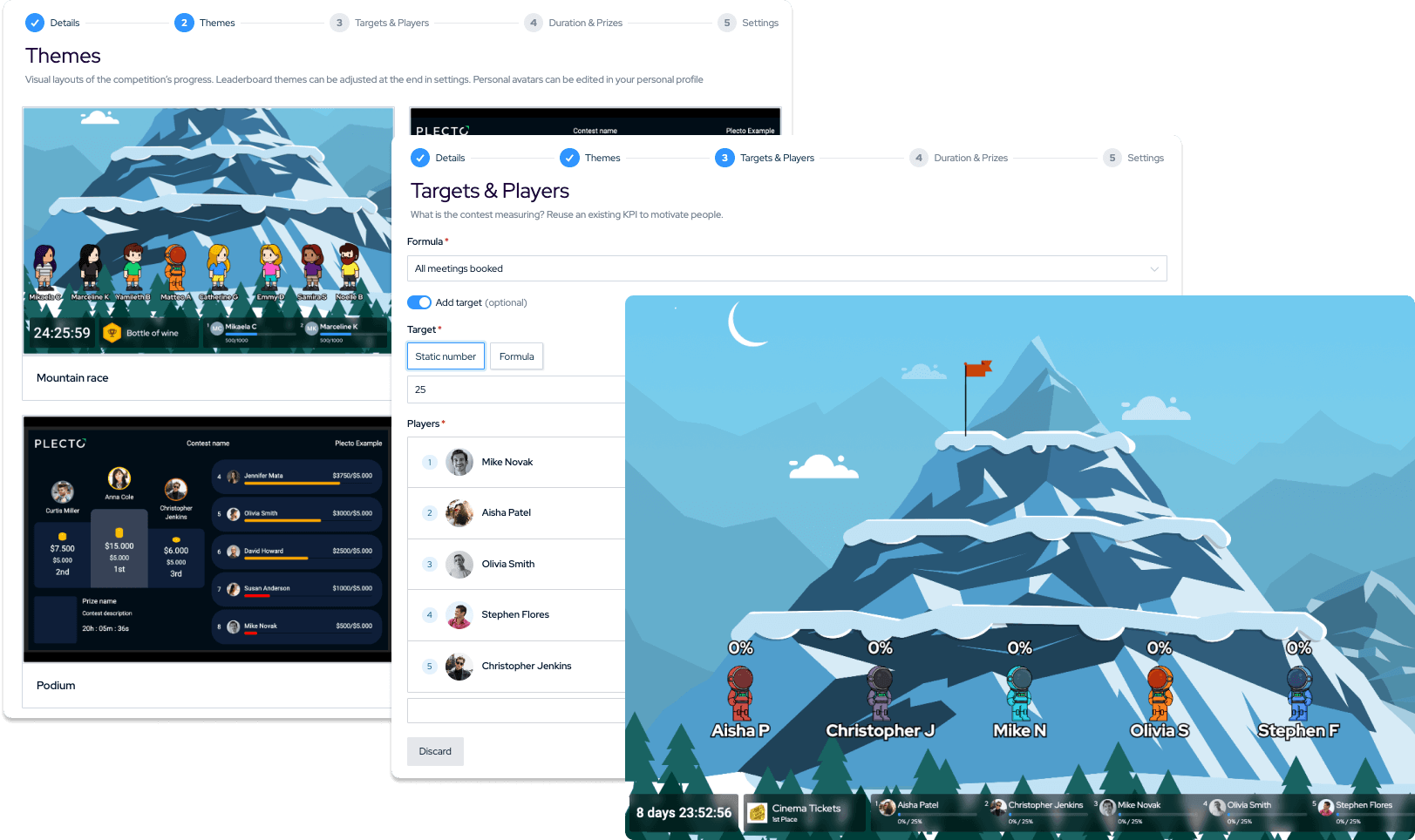
Plecto helps make the pilot visible by giving reps a simple way to track sales opportunities in real time, so activity, acceptance rates, and won opportunities stay visible throughout the month.
Two or three clear mechanics beat 12 confusing ones. A pilot is for learning what people use, not showing every feature.
The tool should fit the workflow reps already have. Prioritize integration over flash. Strong dashboards for sales account managers should pull data automatically, show progress where managers already work, and make coaching easier instead of adding admin.
Implementing the Pilot Program
Once the setup is clear, the pilot has to feel practical in daily work. Reps should know what counts, why it counts, and where to go when something feels off.
Here are the 3 implementation pieces that keep the program moving:
Designing the Gamification Elements
Build scoring around behaviors that predict outcomes. If your goal is a qualified pipeline, reward meetings booked with ICP accounts, discovery calls, and clean opportunity creation.
For example, give 5 points for a first conversation booked with an ICP contact, 10 points for a completed discovery call with required fields filled, 20 points for an SQL accepted by an AE, and a 10% multiplier for multi-threaded deals.
Then add guardrails:
-
Deduplicate contacts.
-
Cap points on repeat actions in a short window.
-
Tie big points to milestones that someone can verify.
This prevents the game from becoming a loophole hunt.
Daniel Apke, founder of Land Portal, has learned to structure incentives around both visible recognition and financial reward, especially when trying to keep people motivated beyond the first push.
He puts it simply: “Based on what I’ve seen, money can help, but it is not always what keeps people engaged. Recognition gives people a sense that their effort is seen. The strongest incentive structures usually balance both, so people feel rewarded financially and valued in front of the team.”
Some reps chase the prize. Others chase status, momentum, or acknowledgement. Good employee recognition gives effort a social signal, not just a payout.
Training and Communication
Run a short kickoff before launch. Show the scoreboard, walk through how points are earned, and explain the bigger reason behind the rules.
People disengage when they do not understand the system.
Make the rules visible. Share examples. Explain what does not count before week 1 starts.
During the pilot, keep a feedback lane open. A Slack channel or weekly office hours is enough. Use plain language:
-
What changed?
-
Why did it change?
-
When will we review it again?
This helps the team trust the process and gives managers a cleaner way to correct confusion before frustration spreads.
Monitoring and Support
Decide what you will track, how often, and who owns the review. Daily leaderboard? Weekly trend snapshot? Midpoint survey?
Track leading indicators such as outreach to ICP accounts, discovery calls held, demos booked, and CRM hygiene. Then track lagging results: SQLs accepted, pipeline created, conversion rates, and win rate on pilot-influenced deals.
Watch activity variance by rep, after-hours spikes, opt-out rates, and signs that the same few people are pulling far ahead.
A practical 30-day timeline can look like this:
-
Days 1 to 5: Finalize rules, connect tools, run training, and validate data.
-
Days 6 to 10: Launch fully, check in daily, fix quirks, and gather impressions.
-
Days 11 to 20: Run 2 themed challenges and send a midpoint survey.
-
Days 21 to 27: Tune point weights, coach away gaming, and gather feedback.
-
Days 28 to 30: Freeze rules, export data, run interviews, and draft the rollout plan.
Support is not only technical. Fix sync issues fast. Keep energy alive with shoutouts, small wins, and coaching when momentum dips. That is where collaborative gamification becomes more than a leaderboard.
Evaluating the Pilot
A pilot only helps if you study it honestly. The goal is not to defend the idea, but to understand what the numbers and the people are telling you.
These are the 3 evaluation steps to complete before a wider rollout:
Collecting Data and Feedback
Pull the numbers, then talk to the people.
Survey the pilot group. Run quick 1:1s. Ask what felt motivating, what felt confusing, and where the friction showed up.
The gamified performance dashboard tells you what happened. The interviews tell you why it happened.
Analyzing Results
Measure outcomes against the goals you set at the start. Did qualified meetings rise by 15%? Did conversion rates improve, or did raw activity simply increase?
Break the results into segments:
-
New reps versus tenured reps
-
Inbound versus outbound teams
-
Different territories or account types
-
High performers versus middle performers
Then look for side effects. Did CRM quality improve? Did reps cut corners? Did managers spend less time chasing updates or more time cleaning messes?
The lesson is simple. Do not overcomplicate the program. If managers constantly explain it, defend it, or manually fix it, the design is not ready.
Adjusting the Strategy
Turn the findings into practical changes.
If outreach volume jumped but SQL quality fell, reduce points for raw dials and raise points for accepted opportunities. If leaderboards discouraged newer reps, add personal-best goals or tiered competitions. If rewards felt flat, test team-based wins or recognition moments in all hands.
Write down what changed and why. Then get sign-off from sales leadership and frontline managers.
This matters because managers carry the rollout. If they do not understand the logic, they will not reinforce it when the program gets busy, messy, or boring.
Rolling Out Gamification to the Entire Team
Use the pilot playbook as your template. Start with a phased rollout by function, region, or team size, and keep the same training and feedback loops that worked during the test.
Give the team a warmup period before results count publicly. Two weeks lets reps learn rules, managers catch data issues, and leadership see whether the system still behaves at scale.
To scale without losing steam:
-
Keep integrations tight so data flows without manual effort.
-
Rotate challenges every few weeks so the program does not go stale.
-
Offer multiple ways to win through individual, team, and personal-best goals.
-
Audit rules quarterly to prevent gaming and protect fairness.
Scaling gamification works best when leaders treat it as an evolving program, not a one-time launch. Novelty wears off. People adapt. The scoring that worked in month 1 may need adjustment by month 4.
Sustained results come from listening after launch, refreshing themes, rotating rewards, inspecting behavior, and keeping the program connected to real sales priorities.
What You Should Do Next
Sales gamification, done thoughtfully, makes progress visible and work a little more energizing. It can lift motivation, tighten process discipline, and nudge the behaviors your strategy depends on.
Start small. Keep the rules simple. Listen closely.
A 30-day pilot gives you enough time to test the idea without overcommitting the team. If you want a tool that brings leaderboards, contests, and recognition into the same place your data already lives, Plecto is worth looking at.
Start your 14-day free Plecto trial today.
Enjoyed the article? Share it:


ROMAN SCHYVDUN