 Sign in
KPI Library
New MRR
New subscriptions added within the month that contribute to your MRR.
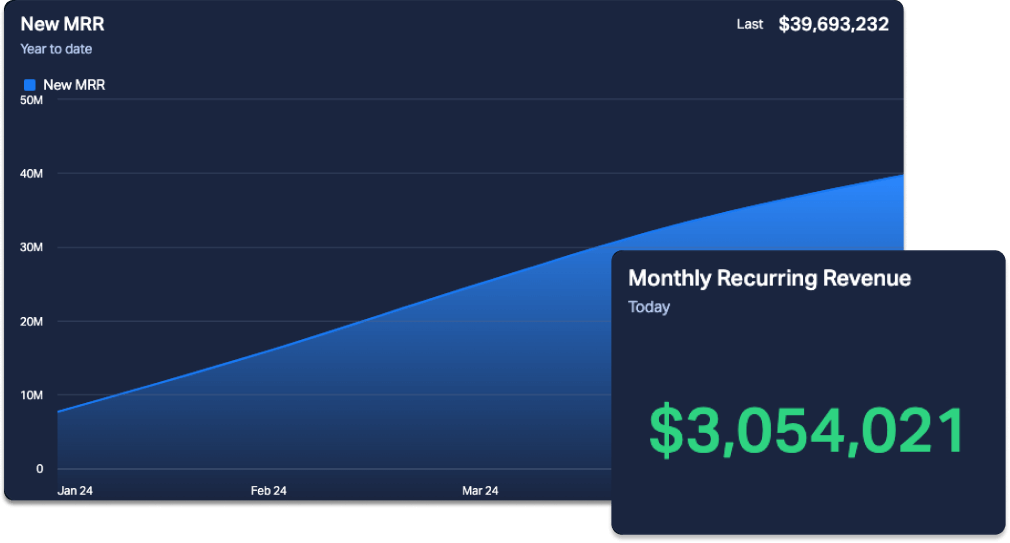
New subscriptions that have been added recently and that will, therefore, contribute to your MRR.
Basically, this KPI shows you the number of new subscriptions you are getting that will be added to your monthly revenue. It’s a useful metric to have a more accurate insight into the short term profitability of the business because it shows data that directly affects your MRR - either positively or not. It can also bring you some learnings about your performance, if for instance, you are below the average new subscriptions you usually get per month. Overall, it’s a common KPI for a manager to keep an eye on because, for example, it might involve changes in the marketing strategy or updated training to the sales department. No matter what your goal is, this KPI will show you how far or close your company is from achieving it on a monthly basis.
KPI Example
What is New MRR?
New MRR (Monthly Recurring Revenue) KPI consists of the value of new subscriptions added to your monthly revenue. It provides useful and accurate insights into your business’ short-term profitability, as it reveals data that directly impacts your MRR, whether positively or not. For this reason, New MRR is a particularly valuable metric for use by subscription-based businesses as opposed to retailers, for example.
New MRR is a relevant metric for your sales team to monitor.
Why is New Monthly Recurring Revenue important?
While it’s a measurement of one simple metric, New MRR gives a wider indication of many other metrics and general trends in your business. It serves as a barometer for your business’ health and it’s easy to see why–if you’re adding new subscribers and therefore New MRR every month, you’re definitely doing something right. On the other hand, if your New MRR isn’t up to par, it’s probably time to take stock, reevaluate, and see what strategies require change.

How to calculate New MRR
New MRR is easily calculated by multiplying the number of new subscribers in the month by the MRR per subscriber.
Be sure to adjust for customers who don’t have a monthly subscription! For customers who have subscribed on an annual basis, divide their subscription by 12 to obtain their monthly rate.
New MRR = New subscribers × MRR per new subscriber

Best practices for New MRR
New MRR is a common KPI for a manager to keep track of, as conclusions drawn from this metric can prompt changes in your:
Subscription strategy
if your current number of new subscriptions in a given month is below average;
Marketing strategy
if you’re not hitting monthly benchmarks in marketing and sales. This revaluation could lead to updates in training your sales department, for example.
Customer acquisition cost, or CAC, is another useful metric to keep in mind when considering new MRR. If you’re spending more to acquire customers than they’re generating in new MRR, your spending efficiency could be improved.
Not to be confused with new MRR, there’s Net New MRR, a closely related KPI that indicates total MRR in the past month from new subscribers and expansion, minus MRR churn.
Because New MRR directly indicates the value of new subscriptions, the only way to increase New MRR is to increase your number of new subscribers. This is why it’s paramount for your marketing and subscription strategies to be rock-solid.