Table of contents:
Gamification Without Competition: Building Collaborative Performance Loops
You know the traditional gamification drill: advertise points, badges, and leaderboards to motivate your team. Suddenly, your sales teams start to compete for the top spot, support agents chase response time records, and engineers collect deployment badges.
But here's the thing. This approach creates unhealthy competition, which can backfire and might not necessarily produce the results you want
Top performers often carry the load until they burn out. Middle performers stop trying because they feel they cannot catch up. Eventually, most of your team learns to hit numbers rather than solve real problems.
What if we flipped the script, and instead of racing against each other, teams work together toward shared wins? That's collaborative gamification, and it's catching on for good reason.
In this article, we’ll explain how this version of gamification works and how to build the performance loops needed.
How Does Gamification Without Competition Work?
Traditional gamification loves winners and losers. You know that scenario where someone's always on top of the leaderboard. Someone's always at the bottom and earns other coworkers’ side snickerings. The bar typically moves differently, one slower compared to the other.
However, collaborative gamification throws that paradigm out the window:
- Your whole team has a shared progress bar.
- Everyone contributes differently, but every contribution counts and is celebrated.
- A junior developer fixes bugs while the senior architect refactors core systems. Different work, same goal. Both move the bar forward.
According to 2023 Cambridge research, teams that cooperate have 50% more productivity and consistently outperform those that compete. Google found something similar with Project Aristotle. Their highest-performing teams had one thing in common: psychological safety. People felt safe to contribute, fail, and learn together.
The magic happens when everyone sees how their work connects. For instance, a junior employee debugging code realizes they're directly helping the senior developer ship features faster. That connection changes everything.
Collaborative gamification thus works by shifting focus from a competitive approach to an interdependent relationship, where one person’s success is everyone’s success. This motivates each member to own the process and do their best to help the entire team scale.
Benefits of Collaborative Gamification in the Workplace
Working gets better when teams stop competing and start collaborating. Here’s why:
- First, people actually talk to each other. No more hoarding information because it might help your "competition.”
- Problem-solving gets better, too. Collective intelligence research on Frontiers found something fascinating. The smartest person in the room rarely determines team performance. What mattered? How well the group worked together. Teams where everyone contributed equally crushed teams dominated by one or two voices.
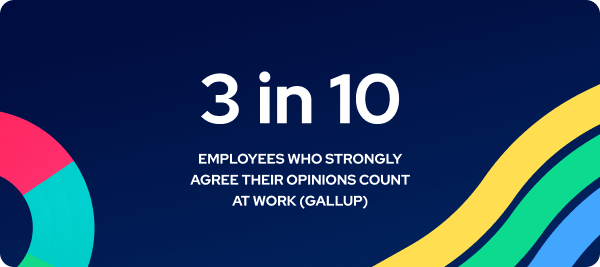
According to Gallup, only 3 in 10 employees feel their opinions count. That creates psychological red flags and high turnover. In contrast, there’s 27% less turnover when you make your teams feel safe. They learn faster. They adapt quicker. And they don't jump ship at the first better offer.
Unhealthily competitive gamification breeds disconnects. Disconnects result in low productivity, burnout, and eventual dropouts. But that changes when you turn tasks and wins into collaborative processes.
This is even more crucial in highly regulated modern industries, such as telemedicine for online consultations, legal systems, and data handling agencies, where teamwork directly affects the end consumers or patients. The more you facilitate collaborative gamification between members, the better their delivery.
Key Elements of Collaborative Performance Loops for Gamification
A performance loop is basically how work flows through your team: Set a goal - Take action - Get feedback - Adjust - Celebrate progress - Repeat the process.
By default, these loops exist to keep your business process running without blockers.
However, most companies build performance-turned-competitive loops without realizing it. Talk about setting individual quotas, personal performance reviews, and giving “employee of the month” awards.
These create a work culture where success means beating your teammates every month. Your team members claw their way up through conscious competitive efforts, not because of team growth or personal improvements.
In the end, this results in team friction and burnout.
To avoid that, you need to introduce some key collaborative elements in your loops:
- Shared objectives that everyone can impact. Not "Sarah needs to close 10 deals" but "Our team needs 40 new customers." Sarah might close deals. Tom might improve the demo. Lisa might streamline onboarding. Different roles, same destination.
- Collective rewards that recognize team wins. Skip the individual bonuses. Celebrate when the team hits milestones together. Make the rewards meaningful – extra time off, team experiences, customized team apparel, or investment in tools everyone's been wanting.
- Ongoing feedback that helps, not judges. Forget annual reviews. Try weekly check-ins where teams share what's working and what's stuck. Make the data visible so everyone knows where to help.
This keeps everyone on the same board, and each employee recognizes how their own success or failure impacts others.

How to Implement Collaborative Gamification with Effective Loops
Building a healthy gamification process without unhealthy competition isn't rocket science. This is how to do it.
1. Identify shared goals
Start small. Pick one thing that matters to both the business and your team. Maybe it's reducing customer churn, improving satisfaction, or simply shipping features faster. Whatever it is, make it specific and measurable.
Then figure out how everyone contributes. Let's say you picked customer satisfaction. Engineers might focus on bugs. Support might improve response times. The product might clarify confusing features. Sales might set better expectations. Everyone plays a part.
2. Map contributions across roles
Once the outcome is clear, break the assumption that everyone contributes the same way. They do not.
Take contract handling as a clear example. Sales initiates the agreement, legal reviews the terms, operations prepares for delivery, and records teams ensure contracts are stored and compliant through a contract management system.
Each role owns a different step, even though everyone aims to achieve the same goal: organizational growth.
Once people can see how their effort connects to the shared goal, collaboration becomes practical. They know where to help and who to involve when progress slows instead of competing to hit the bar first.
- For instance, if legal realizes the existing contract terms are too vague or risky, they can quickly reach out to the content team to clarify language, update templates, or create guidance for sales.
- This is where AI usage by enterprises comes into view. Contract documents for large organizations are often bulky, but with the help of AI tools like GPT and Gemini, content teams can quickly spot what’s wrong, get suggestions to streamline the documents for easy use by sales teams, and determine what to remove.
- Afterwards, content hands off to legal and legal briefs sales team on the changes.
This clear role division and interdependence eliminates unnecessary competition while fostering healthy inputs from everyone involved.
3. Incorporate feedback mechanisms
Feedback keeps your loops alive. But most feedback sucks. Annual reviews arrive after habits have already formed. Daily reports are overwhelming and get ignored. The sweet spot is short, regular check-ins.
Try these patterns:
- Quick standup rounds: "What moved our metric yesterday?"
- Peer shout-outs tied to team goals.
- Weekly team notes highlighting helpful behaviors.
- Simple dashboards everyone can understand.
You can do "Friday wins," where everyone shares what they did to help the team that week – ten minutes max.
4. Utilize metrics and technology for collaboration
Start by choosing two or three metrics tied to your shared goal. Make them visible in one place so everyone sees the same picture. If customer satisfaction dips or delivery slows, the signal should be obvious without someone calling it out.
For instance, imagine you run a local Ontario electrical service provider like Bates Electric, where technicians, dispatch, and office teams all influence response time and customer experience. Instead of tracking individual activity, focus on metrics like call to dispatch, same-day job completion, or repeat visits caused by incomplete work.
Then make those numbers visible to the whole team. This improves coordination because everyone can see where delays are happening and step in to fix them together. Improved coordination enhances service delivery, and customers are satisfied.
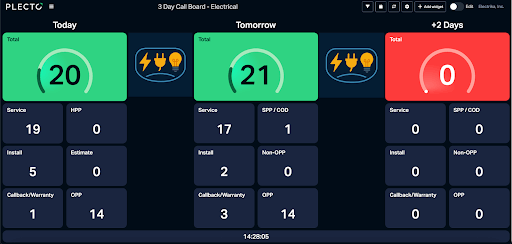
Once you have clarity on what to track, use a tool like Plecto to display those metrics in real time. Set it up as a shared view, not a leaderboard. Review it in team check-ins and agree on where to focus next.
Case Study: Electrika and Shared Performance Visibility
Electrika, a home services company in Montreal, struggled with a familiar problem. Performance data lived across spreadsheets and disconnected systems. Reporting was delayed, and teams had little visibility into how daily work connected to broader goals.
They moved their core metrics into shared, real-time dashboards using Plecto. Instead of relying on individual reports or manager follow-ups, teams could see progress as it happened. Metrics like service calls and inspections were visible to everyone, creating a common reference point.
As visibility improved, behavior shifted. Teams paid more attention to how their work affected shared outcomes. Collaboration increased around inspections and follow-ups, and performance improved without constant intervention.
Conclusion and Future Outlook
Collaborative gamification works because it matches reality. Real work happens in teams, and real success comes from helping each other. Start by building your loops around what you're trying to achieve together.
Make progress visible and celebrate collective wins. Create a safe work environment and culture to keep feedback flowing. Reiterate the entire process once it works, ensure team wins matter more than just individual wins, and encourage team interdependence.
Book your demo with
a Plecto expert today.



ROMAN SHVYDUN
Content Expert and Strategist
As a content creator specializing in SaaS business and marketing, Roman Shvydun writes data-driven articles for SaaS websites. His superpower is converting SaaS “dialects” into a universally understandable “language” with actionable steps for brands and marketers in the field. Roman has become a recognizable voice in SaaS thanks to his fresh ideas and analytical skills. In his spare time, he fishes and “hunts” for new technology trends in the industry and beyond.