
KPI Library
Average of Received Rating Score
Average rating score clients gave your company in the last period.
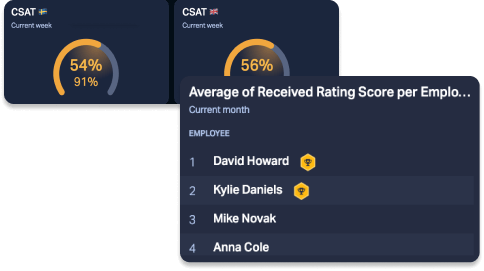
Average rating score clients are giving to your company in the last period.
For any company, it’s always important to get reviews and rating scores from their clients, because they have proved to be of great relevance for potential future customers - and especially for e-commerce. Therefore, it’s important to keep an eye on what your customers are saying at the moment so that you can optimize your product according to the market’s needs. However, your team also needs to make sure that these reviews are positive and improving, which will show that your company actually listens to clients and looks forward to improving. To help your team in this regard, you can display this KPI so that it shows the average rating you have at the moment. Depending on your type of business, you may want to measure not only the overall score but also what clients have to say about each of your Support agents. This will enable you to improve the team’s performance and help those employees that might need more training or advice on how to get better scores.
KPI Example
What is the Average of Received Rating Score?
The Average of Received Rating Score is the average of the scores you’ve received from clients–for example, a 4.5 out of 5 stars. These scores can be found on public online review sites, such as Google or Trustpilot, or can derive from private surveys you’ve sent to clients yourself.
This KPI is not only of relevance to customer-facing departments of your company such as sales and support, but to everyone. Ratings are a direct reflection of your company, serving both as an indicator of your quality and an impactor on your future growth. In short, high ratings will encourage people to do business with you, but low ratings will keep potential customers away.
Why is the Average of Received Rating Score important?
Simply put, the Average of Received Rating Score is important because companies need to know how they’re perceived by the public. In an information-rich economy where internet knowledge often substitutes for word-of-mouth endorsements–and such information is publicly available–companies literally can’t afford to ignore their online reputation.
A high score, therefore, means your company is doing a lot right. While there’s always room for improvement, there’s also a lot to be happy about. In other words, your business is on the right track. If, however, your score is low, it’s time to figure out what needs to be done–and make the appropriate changes as soon as possible.
Ratings and reviews are proven to be highly relevant for attracting potential future customers, especially clients for e-commerce. Therefore, it’s important to keep an eye on what your customers are saying at the moment so you can optimize your product according to the market’s needs.

How to calculate the Average of Received Rating Score
The calculation for the Average Received Rating Score involves finding the mean–that is, the sum of all values (in this case, ratings) divided by the number of values. The period for finding this score (day, month, year, etc.) is variable and depends on your company’s needs.

How to improve your Average of Received Rating Score
The best way to improve your Average of Received Rating Score is to improve your product/service, customer experience, and customer support–essentially, improve your business all around. Make your customers so happy they’ll be willing to give you a good rating or review completely unprompted. This is why this KPI is so important: it’s a group effort!
Take a look at these other telephony KPIs from Plecto related to Average Received Rating Score: