 Sign in
Why Gamification Is More Effective Than Annual Reviews for Building Long-Term Employee Motivation
Gamification beats annual reviews for lasting motivation, if you pick metrics that age well, keep them on a live wallboard, and reset before novelty fades.
Why Gamification Is More Effective Than Annual Reviews for Building Long-Term Employee Motivation
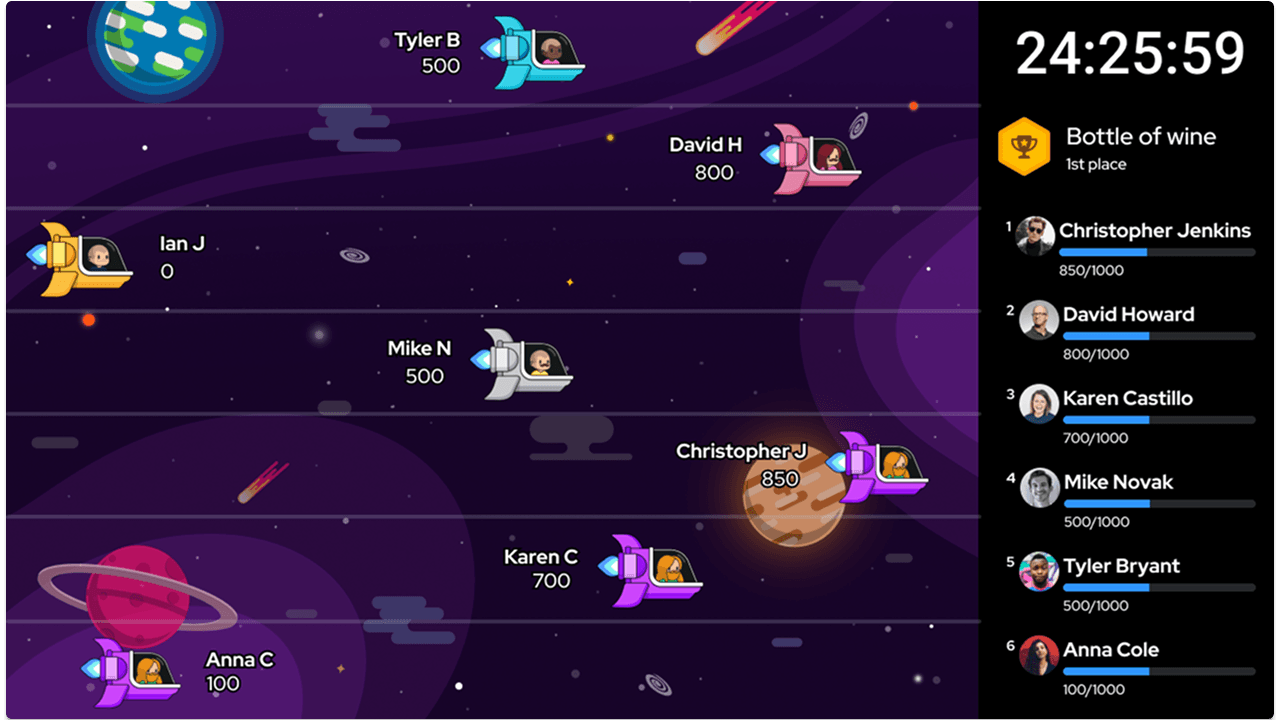
Every gamification rollout has the same first week. The leaderboard goes up, someone wins a badge before lunch, the floor is loud, and a manager screenshots the dashboard for the all-hands deck.
Then week nine arrives. The same three names sit at the top of the board. The streaks nobody broke stopped meaning anything. The badges land in a channel nobody reads. Participation didn't crash, exactly. It just went to zero while the screen kept glowing.
That decay curve, not the launch, is the real design problem. Points and prizes are easy. Building a system that still changes behavior in month six is the hard part, and it is mostly a question of what you put on the wallboard and how often you're willing to change it.
The Novelty Curve Is Not a Motivation Problem
New mechanics produce a spike because novelty itself is rewarding. That spike was never going to hold, and treating its decline as failure misreads what happened.
What sustains effort after the novelty burns off is something plainer: visible progress on work that matters. Teresa Amabile's research on the progress principle found that of everything capable of lifting motivation during a workday, the single biggest factor was simply making progress in meaningful work, and that people are more often energized by small wins than by rare big ones.
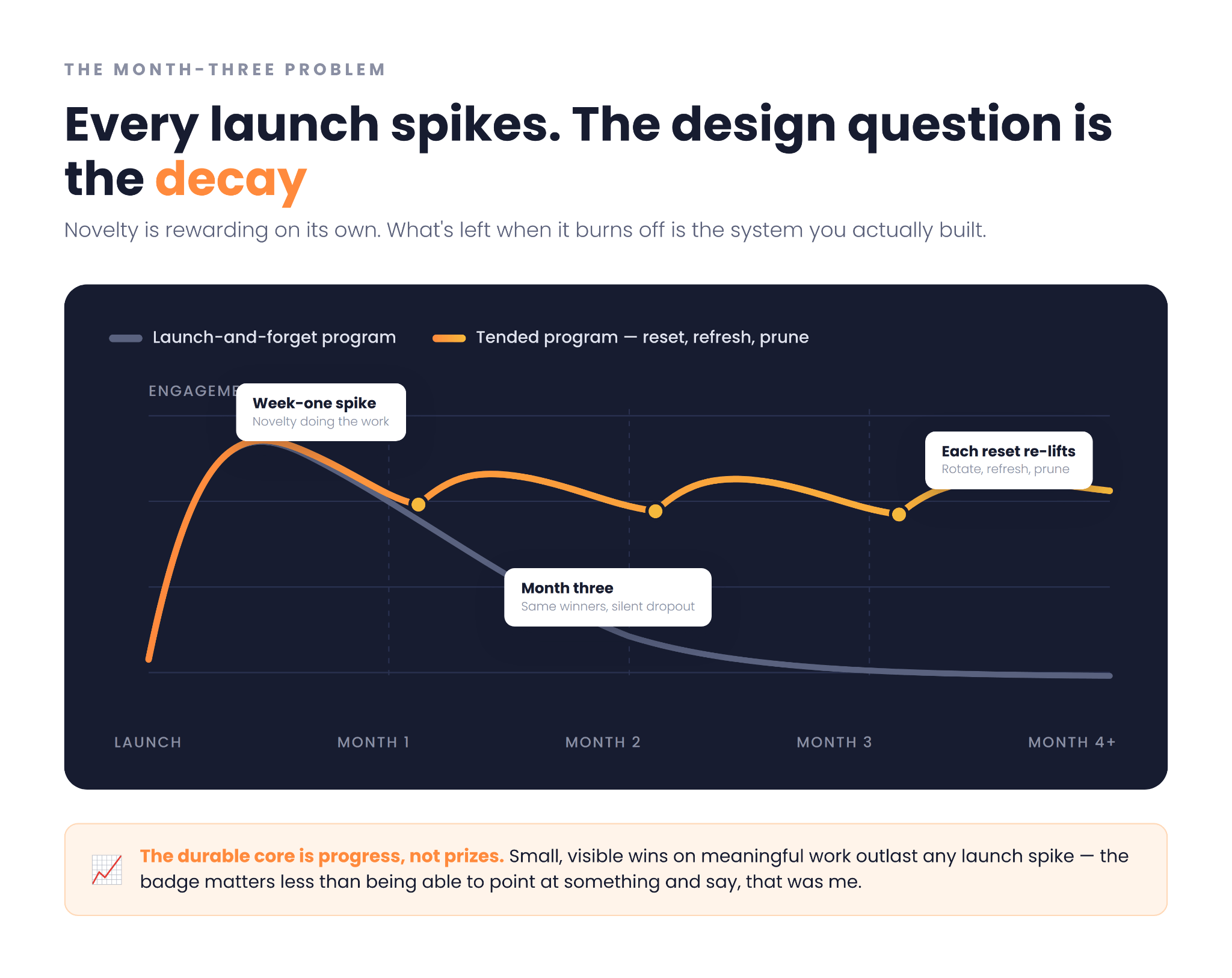
Read that against the typical rollout and the month-three slump explains itself. The launch delivered novelty. It never delivered a reliable, daily view of progress. When the novelty went, nothing was left underneath.
Recognition works the same way. It compounds when it's tied to specific, visible effort, and evaporates when it's generic.
Conrad Wang, Managing Director of EnableU, leads frontline care teams where consistency and morale directly shape client outcomes.
He says, "In care work, most of the effort is invisible by default. Nobody sees the hundred small things a support worker gets right in a shift. When we started making that work visible through simple recognition loops, the change was immediate.
People stopped feeling interchangeable. They could point to something concrete and say, that was me, I did that, and that feeling carries into the next shift."
That is the durable core. Not the badge. The pointing.
The Wallboard Is the Persistence Layer
A gamification app holds the game. A wallboard holds the attention, and attention is the resource that decays.
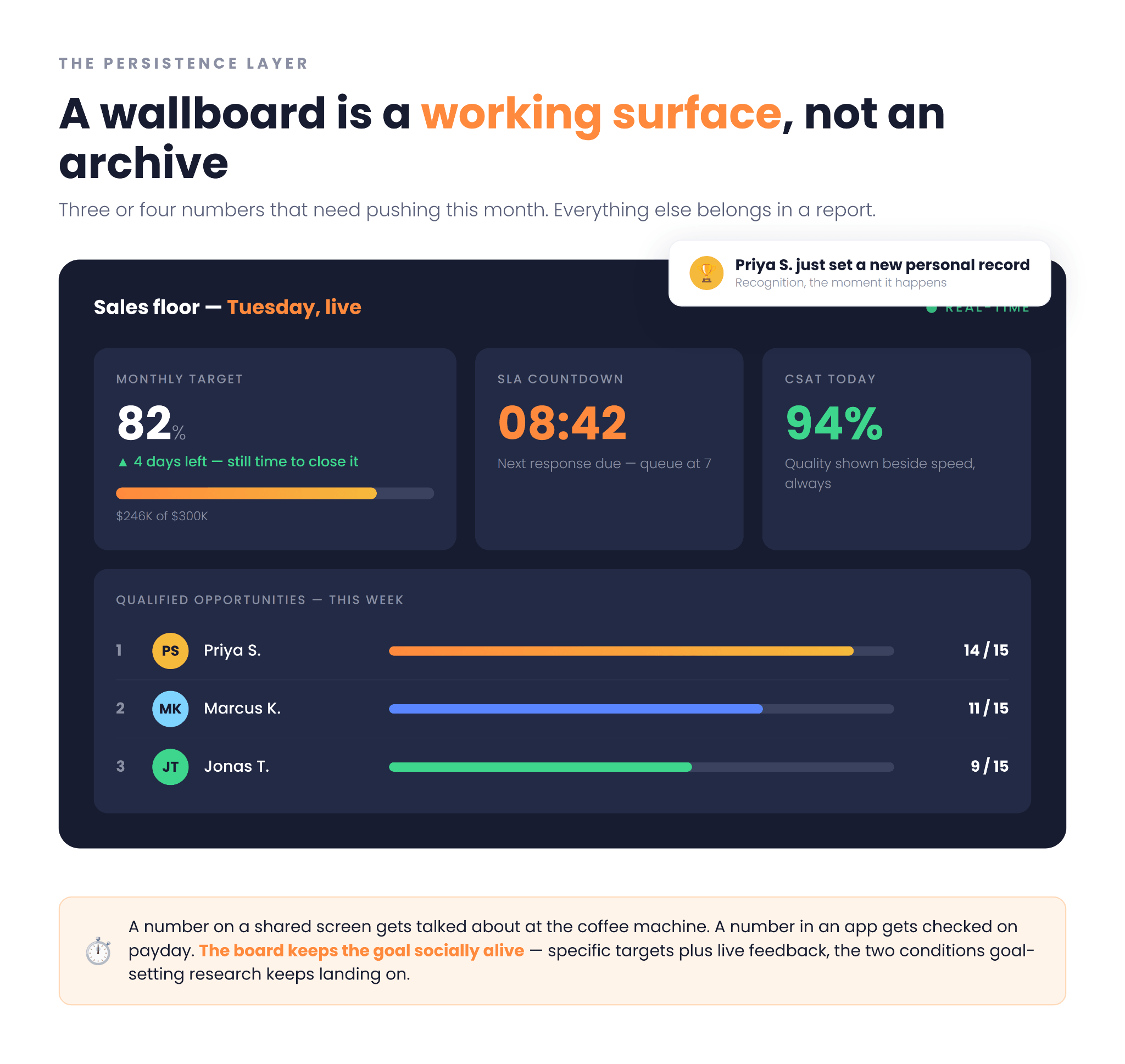
Goal-setting research going back to Locke and Latham keeps landing on the same pair of conditions: goals drive performance when they are specific and when people get feedback on where they stand. A wallboard is both conditions bolted to a wall. Today's target, today's gap, updated while there's still time to close it.
It also does something a private app can't: it keeps the goal socially alive. A number on a shared screen gets talked about at the coffee machine. A number in an app gets checked on payday.
The mistake is treating the board as an archive. It isn't storage. It's a working surface for the three or four numbers that need pushing this month, and everything else belongs in a report.
Choose Metrics That Age Well
Most decayed programs pick metrics with short shelf lives, numbers that stopped teaching anyone anything after week four, or worse, got gamed into noise.
A rough sorting rule: metrics age well when the team controls them daily and gaming them is harder than doing the work.
| Ages well on a wallboard | Decays or gets gamed | |
|---|---|---|
| Sales KPIs | Qualified opportunities, pipeline updated within 24h of a call, win rate | Dials, emails sent, raw meeting count |
| SaaS KPIs | Activation rate, time-to-value, support QA scores | Logins, feature clicks, ticket close volume |
| Team health | Peer recognition frequency, challenge participation | Hours logged, badge totals |
The left column shares a property: each number is a proxy for a behavior you'd want even if no one were counting. The right column shares the opposite one: hit those numbers hard enough, and you often make the real work worse.
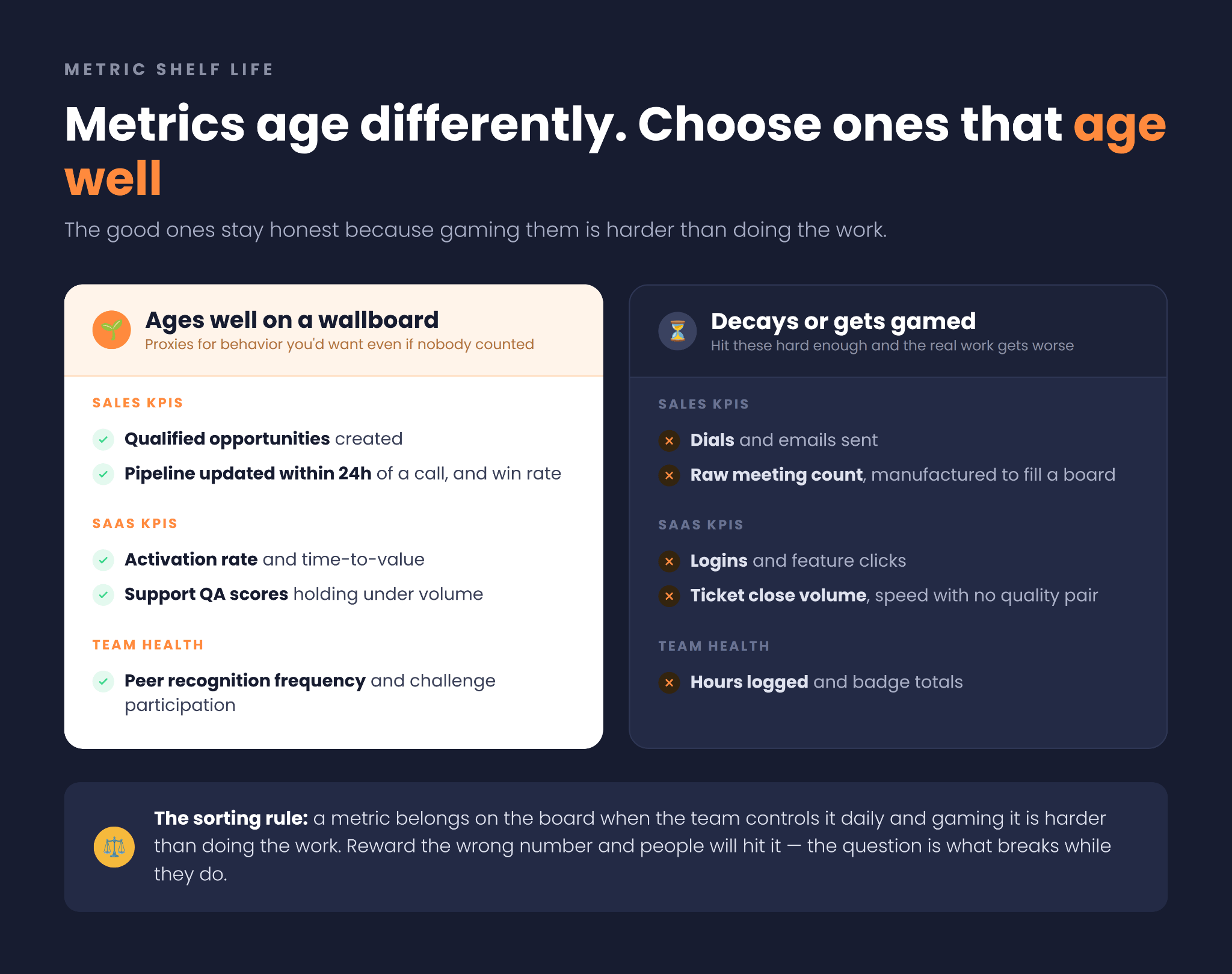
The cautionary version of this is not hypothetical. When hospital systems gamified throughput and rewarded discharge speed above everything else, corners got cut, and some of that fallout surfaced years later as medical negligence claims. Reward the wrong metric, and people will hit it. The question is what breaks while they do.
A Rollout Designed to Survive the Quarter
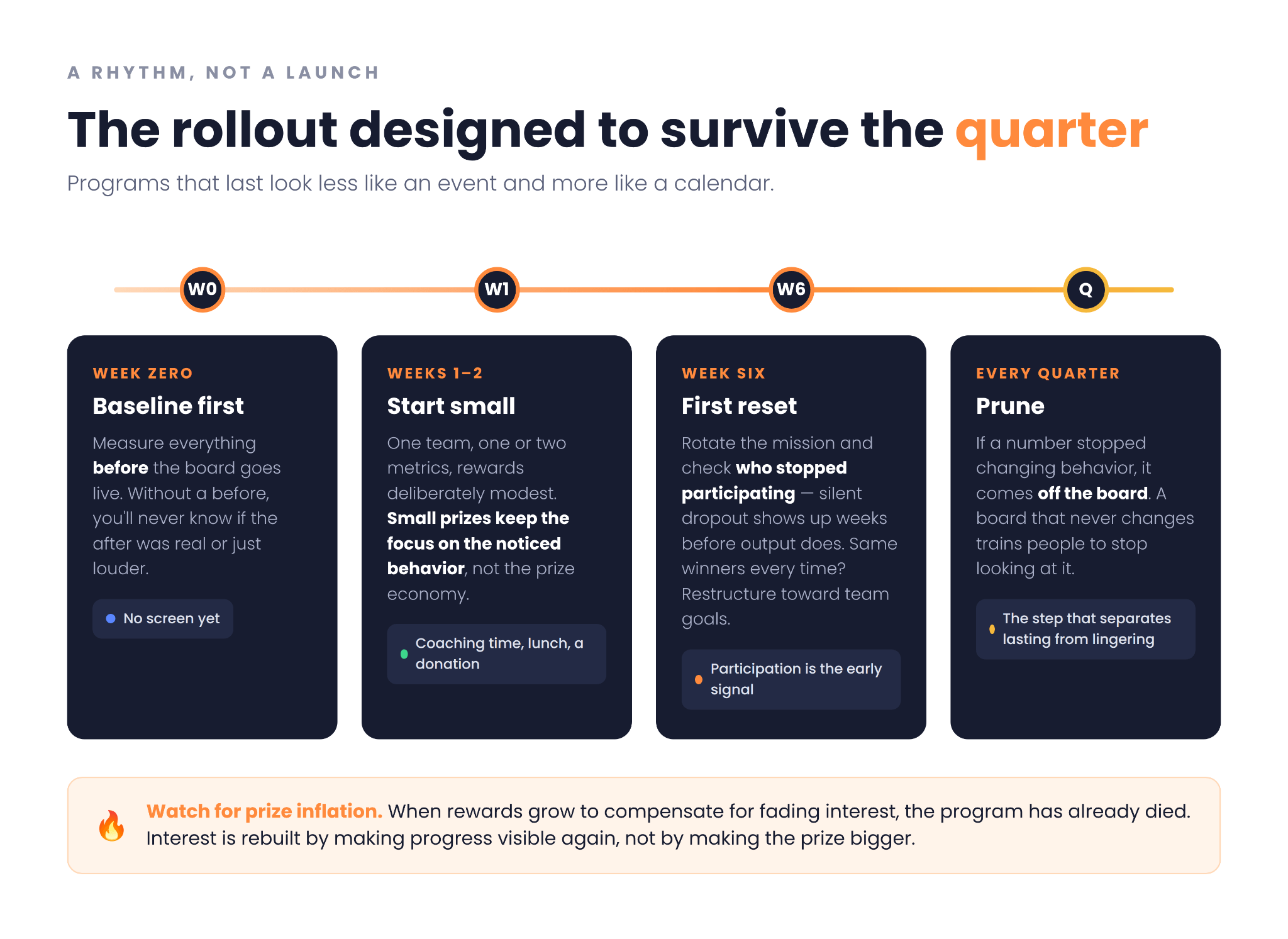
Programs that last tend to follow a rhythm rather than a launch. It looks less like an event and more like a calendar.
-
Week 0. Baseline everything before the board goes live. Without a before, you will never know whether the after was real or just louder.
-
Weeks 1-2. One team, one or two metrics, rewards deliberately small. Coaching time, lunch, a donation in the winner's name. Small rewards keep the focus on the noticed behavior instead of the prize economy.
-
Week 6. First reset. Rotate the mission, refresh the challenge, and check who has stopped participating. Silent dropout is the earliest decay signal, and it shows up in participation weeks before it shows up in output. If the same people keep winning, restructure toward team goals or handicapped targets before everyone else checks out.
-
Every quarter. Prune. This is the step that separates programs that last from programs that linger.
Ryan Beattie, Director of Business Development at UK SARMs, tracks sales KPIs daily across a fast-moving e-commerce operation.
He says, "The wallboard is only as honest as the KPIs you put on it. We track a small set that actually predicts revenue, watch how they move week over week, and prune anything the team starts gaming. If a number stops changing behavior, it comes off the board. Review it quarterly like that, and the system keeps working long after the novelty wears off."
Pruning sounds like housekeeping. It's actually the whole mechanism. A board that never changes trains people to stop looking at it, and a board nobody looks at is a heater.
Decay Has Friends
Novelty loss is the natural failure mode. Three others are self-inflicted.
A punitive culture turns any public board into a threat display. If people are already afraid of the numbers, making the numbers bigger and brighter deepens the fear. Fix the culture first or don't put up the screen.
Privacy carelessness burns trust faster than any prize can rebuild it. Track only what's job-relevant, tell people exactly what's displayed and why, and default to team-level views, using individual data sparingly and with consent.
This is especially important in regulated professions such as healthcare and family law, where confidential patient and client information should never appear on shared dashboards. The same principle applies across industries: if information isn't necessary to support team performance, it doesn't belong on a public wallboard.
When rewards grow to compensate for fading interest, the prize inflation program has already died. You're just paying more for the corpse. Interest is rebuilt by making progress visible again, not by making the prize bigger.
Start Smaller Than Feels Impressive
One metric the team controls. One clean wallboard. One mission with a six-week expiry date and a reset already on the calendar. Measure the baseline first, watch participation as closely as output, and prune on schedule even when nothing seems broken.
The programs that work in month six are never the ones that launched loudest. They're the ones somebody kept tending.
For teams that want the contests, recognition, and live performance data managed in one place, Plecto gives those moving parts a single home to work from.
Start your 14-day free Plecto trial today.
Enjoyed the article? Share it:


BROOKE WEBBER