 Sign in

40 Gamification Statistics for 2026
Gamification statistics for 2026: 40 verified stats on market size, workplace use, sales rankings, contact centers, training and risks, each with its source.
These gamification statistics cover what the research actually says about using game mechanics at work: how big the market is, how many employees see gamification, what leaderboards do to sales performance, how contact center teams respond, and where gamification goes wrong. We traced every number to its original source, such as the publisher's own report, a peer-reviewed paper or a university release, and left out the widely shared figures we could not trace. Those are listed at the end, with the reason.
Most gamification statistics online are copied from list pages that copy each other. A number with no source is not much use when you are building a business case for sales gamification or defending a contest budget, so each statistic below links to where it comes from.
Key gamification statistics at a glance
- Market research firms put the 2025 gamification market between USD 16.2 billion and USD 36.9 billion, growing 17% to 27% a year.
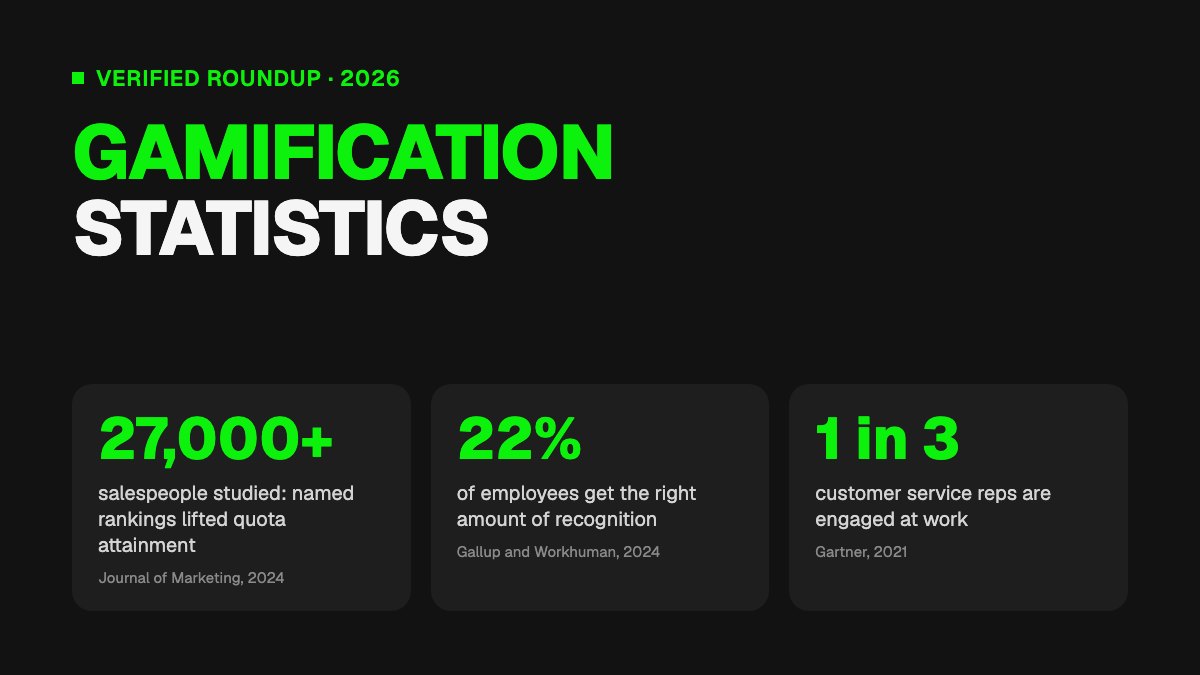
- In a study of more than 27,000 salespeople in 170+ firms, named performance rankings had the strongest positive effect on quota attainment and turnover.
- Showing quotas next to named rankings removed the benefit.
- 89% of employees who had experienced gamification at work said it made them feel more productive (self-reported, 2019).
- Only one in three customer service reps are engaged on the job.
- Just 22% of employees say they get the right amount of recognition.
- Meta-analyses find small to large positive effects of gamification on learning, and one found the effect strongest in shorter programs.
- In 2012, Gartner predicted that 80% of gamified applications would fail to meet business objectives, mainly because of poor design.
Gamification market size statistics
Market estimates vary by about two times between research firms, because each one defines the market differently. Always quote the publisher and the year with the number.
| Publisher | 2025 market size | Forecast | Annual growth (CAGR) |
|---|---|---|---|
| Fortune Business Insights | USD 36.86 billion | USD 308.85 billion by 2034 | 26.64% |
| Mordor Intelligence | USD 29.11 billion | USD 112.32 billion by 2031 | 25.24% (2026–2031) |
| IMARC Group | USD 26.3 billion | USD 113.2 billion by 2034 | 17.08% (2026–2034) |
| Expert Market Research | USD 16.23 billion | About USD 98.83 billion by 2035 | 19.80% (2026–2035) |
- Fortune Business Insights values the global gamification market at USD 36.86 billion in 2025 and expects 26.64% annual growth to 2034.
- Mordor Intelligence puts the market at USD 29.11 billion in 2025 and USD 36.46 billion in 2026, reaching USD 112.32 billion by 2031.
- IMARC Group estimates the market grew from USD 26.3 billion in 2025 to USD 32.1 billion in 2026.
- Expert Market Research gives the lowest 2025 estimate: about USD 16.23 billion.
- North America held 42.97% of the gamification market in 2025, according to Fortune Business Insights.
- Cloud-based solutions controlled 67.62% of gamification revenue in 2025, and large enterprises held 57.02% of the market (Mordor Intelligence).
Workplace gamification statistics
The best-known workplace gamification statistics come from one source: TalentLMS's 2019 Gamification at Work survey, which surveyed almost 900 employees. The answers are self-reported feelings, not measured output, so quote them that way.
- Employees who had encountered gamification at work said it makes them feel more productive (89%) and happier (88%) at work (TalentLMS, 2019).
- 43% of employees had not noticed any gamification elements at work (TalentLMS, 2019).
- The most common gamification elements at work were badges (71%), points (59%), rewards (56%), leaderboards (51%) and levels (47%) (TalentLMS, 2019).
- 78% said gamification in the recruiting process would make a company more desirable (TalentLMS, 2019).
- In 2011, Gartner forecast that by 2014 more than 70% of Global 2000 organizations would have at least one gamified application. It was a prediction, not a survey result.
- A 2025 study of 217 employees in Frontiers in Psychology linked work gamification to higher creativity through intrinsic motivation, and found the effect depended on how much employees accepted the gamification.
Want to see how these elements look in practice? Plecto combines achievements and badges, contests and a reward store on top of live KPI dashboards.
Employee engagement statistics behind gamification
Gamification gets attention because engagement is low and expensive. These statistics are about engagement in general, not gamification itself.
- Only 20% of employees worldwide were engaged in 2025, the lowest level since 2020 (Gallup, State of the Global Workplace 2026).
- As of August 2026, 29% of US employees are engaged and 18% are actively disengaged (Gallup).
- Compared with bottom-quartile units, teams in the top quartile of engagement had 18% higher productivity (sales), 23% higher profitability and 78% lower absenteeism in Gallup's 2024 meta-analysis of 183,806 business units across 347 organizations (Gallup).
- In a 2023 survey of 400 employees published in F1000Research, a study of gamification at work found that employee recognition and perceived motivation had a positive impact on productivity.
For more on the link between motivation and results, see our team motivation statistics.
Sales gamification statistics
Leaderboards are the most common sales gamification mechanic, and the research on them is more nuanced than most vendors admit. How rankings are shown matters as much as whether they exist.
- A Journal of Marketing study of more than 27,000 salespeople from 170+ firms in 83 countries found that identifiable (named) performance rankings had the most substantial positive impact, improving quota attainment and reducing turnover (2024).
- In the same research, when quotas were disclosed alongside names and rankings, the performance benefits disappeared.
- Anonymized rankings also raised quota attainment, but led to higher turnover (Journal of Marketing, 2024).
- In a leaderboard experiment published in Computers in Human Behavior, participants implicitly set goals at or near the top of the leaderboard, which helps explain why a leaderboard can work like a difficult goal (Landers, Bauer and Callan, 2017).
- KPMG offices that used a gamified training platform with a global leaderboard saw a 16% rise in the number of clients and fees up by more than 25%, according to a study across 24 offices reported by Columbia Business School (2023).
- In a three-year field experiment with furniture salespeople, sales went up after rankings were removed, the researcher told Knowledge at Wharton. Rankings help some teams and hurt others.
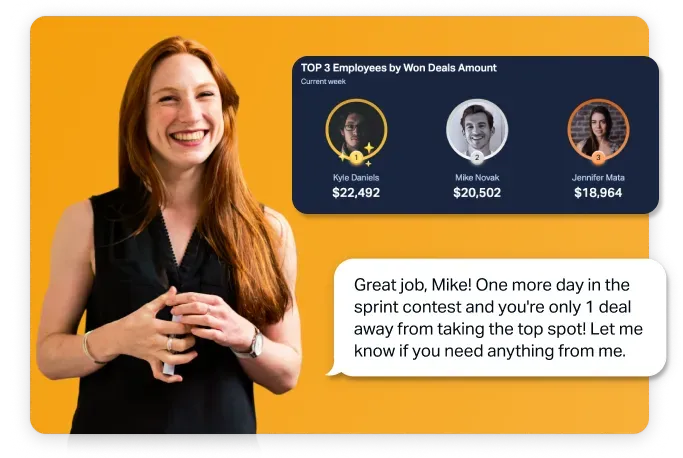
What this means in practice: show named rankings on KPIs reps control, keep quota discussions out of the public leaderboard, and give the middle of the table something to win. Our guide to sales leaderboards and sales floor gamification mechanics covers how.
Contact center gamification statistics
Customer service and call center teams face the steepest engagement problem, and it is where call center gamification is meant to help.
- Only one in three customer service reps are engaged on the job; the rest are neutral or disengaged (Gartner, survey of 600 reps, 2021).
- Disengaged reps are 84% more likely to look for a new job than engaged reps, and even neutral reps are 43% more likely (Gartner, 2021).
- Disengaged reps drive high-effort customer experiences three times as often as engaged reps, and Gartner links disengagement to unclear or conflicting goals (2021).
- Two call center field experiments found negative effects of gamified work on employee engagement and well-being, moderated by how willing employees were to take part (Hammedi et al., Journal of Business Research, 2021).
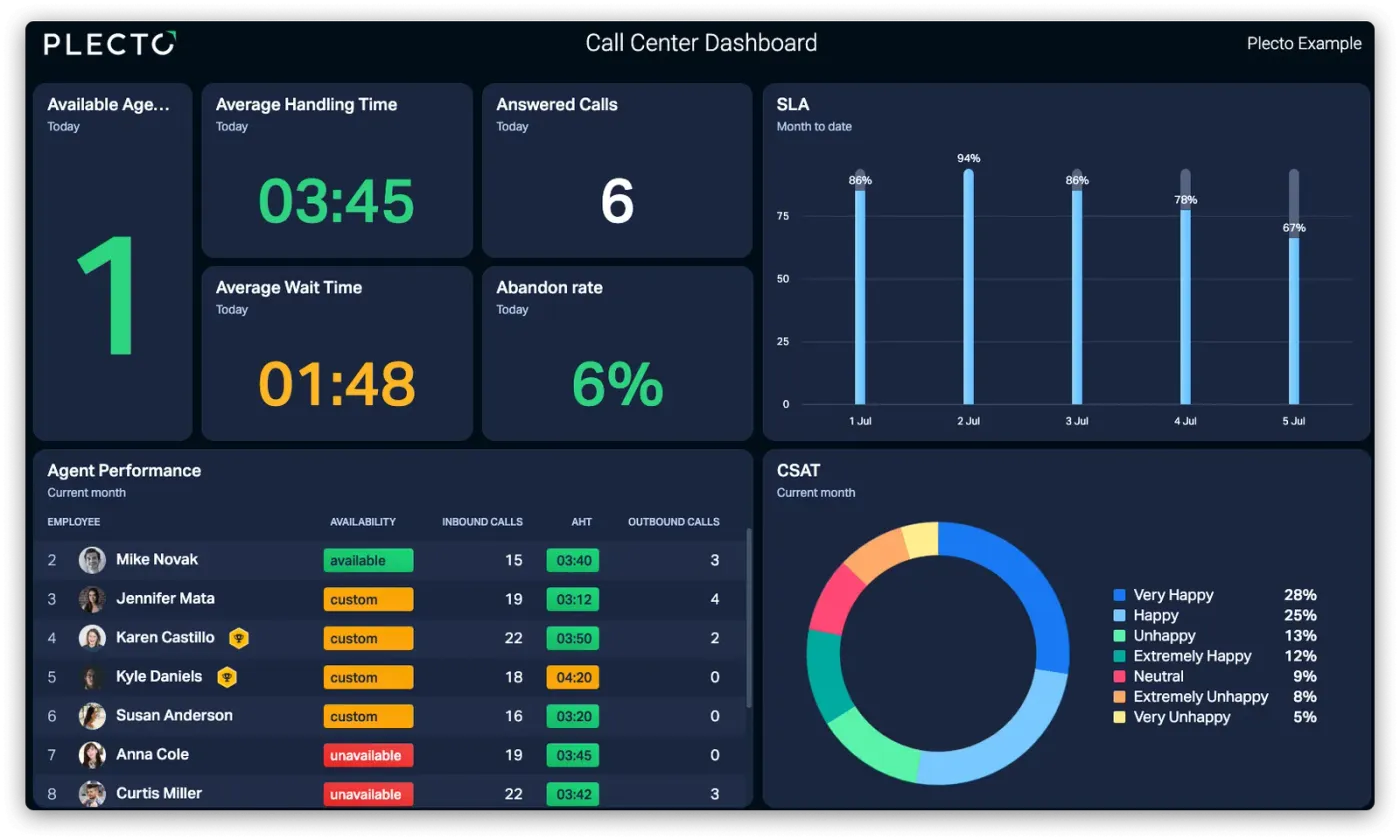
The takeaway for service leaders: clear goals come first, and participation should feel like a choice. See how customer service gamification works in Plecto.
Gamification in training and learning statistics
Training is where gamification has the most controlled research, including several meta-analyses.
- A meta-analysis by Sailer and Homner found significant small effects of gamification on cognitive (g = .49), motivational (g = .36) and behavioral (g = .25) learning outcomes (Educational Psychology Review, 2019).
- A 2023 meta-analysis of 41 studies and more than 5,071 participants found an overall large effect of gamification on learning (g = 0.822) (Li, Ma and Shi, Frontiers in Psychology).
- Gamification improved behavioral change in education with an effect size of d = 0.48, and short interventions (1.57) worked far better than ones lasting up to 20 weeks (0.30) (Kim and Castelli, 2021).
- 61% of surveyed employees receive training with gamification, and 83% of them feel motivated by it (TalentLMS, 2019).
Plecto's coaching and training tools add quizzes and one-on-ones to the same platform as your dashboards.
Employee recognition statistics
Recognition is the reward side of gamification: badges, shout-outs and celebrations on screen. Gallup and Workhuman tracked nearly 3,500 employees from 2022 to 2024.
- Just 22% of employees say they get the right amount of recognition for their work, unchanged from 2022 (Gallup and Workhuman, 2024).
- Well-recognized employees are 45% less likely to have left their company after two years (Gallup and Workhuman, 2024).
- Employees whose recognition meets at least four of Gallup's five recognition pillars are nine times as likely to be engaged as those whose recognition meets none (Gallup and Workhuman, 2024).
- 55% of US employees either receive no recognition or none that meets any of the five pillars (Gallup and Workhuman, 2024).
- As of August 2026, 27% of US employees say they received recognition or praise for good work in the past seven days (Gallup).
- Employees who do not feel adequately recognized are twice as likely to say they will quit in the next year (Gallup).
Gamification statistics on risks and failure
Gamification can backfire. These statistics explain most of the failures.
- In 2012, Gartner predicted that by 2014, 80% of current gamified applications would fail to meet business objectives, primarily because of poor design. It was a forecast, not a measured failure rate.
- Gartner blamed a focus on points, badges and leaderboards rather than the more subtle and more important game design elements (2012).
- In an experiment with 355 employees, higher gamification intensity in virtual training lowered perceived autonomy (European Journal of Work and Organizational Psychology, 2025).
- A West Virginia University experiment found that game elements boosted productivity in repetitive assembly work, but also increased the frustration, time pressure and mental demands participants reported (2024).
The pattern is consistent: gamification fails when it is all points and pressure, when it runs too long without a refresh, and when people feel forced to play. Avoid the most common traps with our list of gamification mistakes.
Gamification results from Plecto customers
Results reported by Plecto customers in their own case studies. They combine live dashboards with gamification, and several customers point out that other changes contributed too.
- POS Nation: topline sales up 23%, new accounts won up 14% and closing rate up 9% in the year Plecto was implemented (case study).
- Jyllands-Posten: the direct sales team increased sales revenue by 26.9% within three years of introducing Plecto (case study).
- emploio: employees stick to activity targets 99% of the time, and appointment rates rose by 300% (case study).
- Electrika: performance improved by an estimated 15–20% after adopting real-time dashboards, with leaderboards, badges and competitions on top (case study).
- Inception Plumbing: conversion rose from 68% to a consistent mid-70s within a month (case study).
- If Forsikring Commercial: closed the year with about 50% more sales, which the team says was not solely due to Plecto (case study).
Popular gamification statistics that don't hold up
These numbers appear on many statistics pages. We could not trace them to an original source, or the original says something different.
- "Gamification increases productivity by 50%." We found no study behind it. It appears on list pages without a source.
- "89% of employees are more productive with gamification." The source is the TalentLMS 2019 survey, where 89% said gamification makes them feel more productive. It is a perception, not a measured gain.
- "Gamified training raised KPMG's sales by 35.8%." We could not find this figure in any source we could open. Columbia Business School's write-up of the study reports 16% more clients and fees up by more than 25%.
- "Removing rankings raised sales by 11%." The Wharton interview with the researcher confirms that sales went up, but gives no percentage.
- "80% of gamification projects fail." Gartner's 2012 figure was a prediction about 2014, not a measured result.
What these gamification statistics mean for your team
- Name the leaderboard, not the quota. Identifiable rankings worked best; showing quotas beside them erased the gain.
- Mix competition with collaboration. Team goals and shared milestones keep the middle of the table engaged.
- Keep games short and refresh them. Effects are strongest in short programs, so run two-week contests rather than year-long ones.
- Recognize often and specifically. Most employees feel under-recognized, and recognition is strongly linked to staying.
- Start from clear goals. Disengagement in service teams follows unclear or conflicting goals, so align KPIs before adding game mechanics.
- Make participation feel voluntary. Gamification that feels forced can lower engagement and well-being.
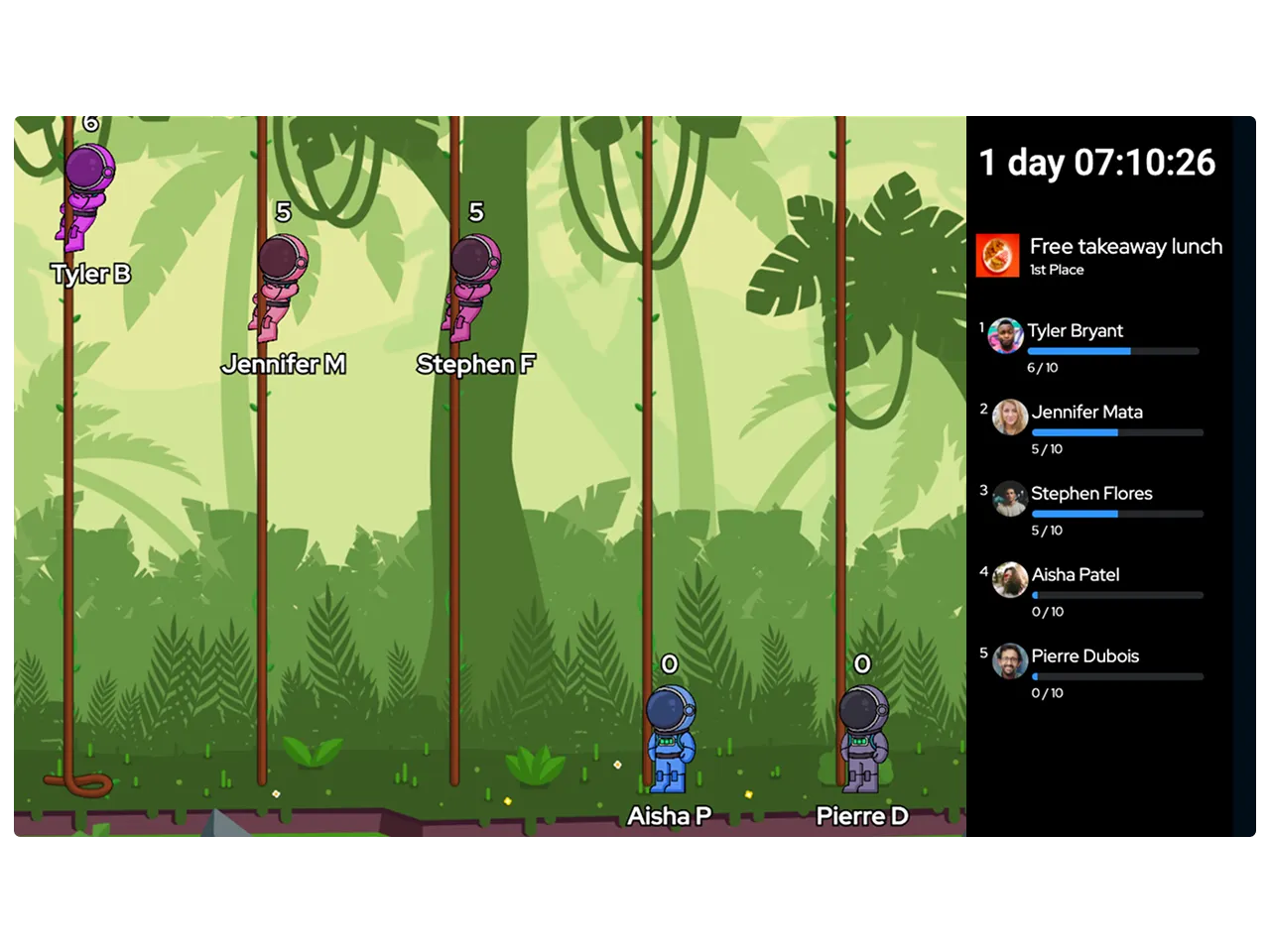
Plecto puts these principles into one platform: live KPI dashboards, named leaderboards, team contests, achievements and a reward store, connected to 150+ tools. Compare options in our sales contest software roundup or see how Plecto gamification works.
How to cite these statistics
You are welcome to use these gamification statistics in your own articles, reports and presentations. Please link to this page and to the original source listed with each statistic.
Questions
Frequently asked questions about gamification statistics
Estimates for 2025 range from about USD 16.2 billion (Expert Market Research) to USD 36.9 billion (Fortune Business Insights), with forecast growth of 17% to 27% a year. The range is wide because research firms define the market differently, so always cite the publisher and year.
The evidence is positive but mixed. In TalentLMS's 2019 survey, 89% of employees who had experienced gamification said it made them feel more productive. Controlled studies find gains too, such as a West Virginia University experiment in 2024, but also report more stress and lower autonomy when gamification is too intense.
Usually, if they are designed well. A Journal of Marketing study of more than 27,000 salespeople found named rankings improved quota attainment and reduced turnover, but the benefit disappeared when quotas were shown next to the rankings. A Wharton field experiment found a team that sold more after rankings were removed.
In TalentLMS's 2019 survey, 43% of employees had not noticed any gamification at work, and 61% of respondents received training with gamification. There is no reliable recent figure for overall workplace adoption.
Mostly because of poor design. Gartner predicted in 2012 that 80% of gamified applications would miss their business objectives for that reason, citing a focus on points, badges and leaderboards over balanced design. Research also shows that forced participation and long, unchanged programs reduce the effect.
Start your 14-day free Plecto trial today.
Enjoyed the article? Share it:


