 Sign in

What Is a SPIFF? Meaning, Examples and How to Run One
What is a SPIFF? Learn the SPIFF meaning in sales, how SPIFF bonuses differ from commission, 9 examples, and how to set up and track a SPIFF program.

What is a SPIFF, and when is it worth paying one? A SPIFF is a short-term sales incentive that rewards one specific result, such as selling a new product or booking meetings this month. This guide explains what the term means, how it works, how it differs from commission, nine examples, how to set up a program and how to track it live. Note that "Spiff" is also the name of a commission software product; this article is about the incentive itself.
What is a SPIFF?
A SPIFF is a short-term bonus paid to salespeople for a specific action or result, such as selling a particular product, booking demos or closing deals before a deadline. It sits on top of normal pay and commission. Because it has a narrow goal and an end date, it steers effort now without changing the permanent compensation plan.
The word is spelled "SPIFF", "SPIF" or "spiff". Sources disagree on what the letters stand for. The most common expansion is Sales Performance Incentive Fund. Others give Sales Program Incentive Fund or Sales Promotion Incentive Fund. Pipedrive notes that the Oxford English Dictionary traces the word back to 1891, long before modern sales teams, so treat any single tidy origin story with caution.
What matters in practice is the shape of the thing: one goal, one time window, one reward. If you are looking at the SPIFF meaning in sales, that is the core of it.
How a SPIFF works
A SPIFF works by attaching an extra reward to a behavior you want more of, for a limited time. Management picks the target behavior, sets a payout and a deadline, tells the team, and pays out when the condition is met.
The usual flow looks like this:
- A business need appears: a product launch, slow-moving stock, a quiet quarter or a pipeline that is too thin.
- The manager defines the SPIFF: what counts, who is eligible, what it pays and when it ends.
- Reps see their progress while the SPIFF runs.
- At the end, results are checked and the reward is paid, usually in the next payroll or as a gift card, experience or other prize.
A SPIFF can be individual, where each rep earns for their own results, or team-based, where everyone shares a reward when the group reaches a goal. It can pay for outcomes (deals closed) or for activities (calls made, demos booked), as long as the measure is clear and cannot be argued about later.
SPIFF vs commission vs bonus vs sales contest
People mix these up, and the confusion leads to badly designed incentives. Here is how they differ:
| SPIFF | Commission | Bonus | Sales contest | |
|---|---|---|---|---|
| Purpose | Push one specific product or behavior | Reward all sales results | Reward target or company performance | Create friendly competition and visibility |
| Duration | Short: days to a quarter | Ongoing, built into the plan | Usually quarterly or annual | Short, with a fixed end |
| Typical payout | Fixed amount, gift card or prize | Percentage of revenue or margin | Fixed or variable sum | Winners get a prize; sometimes everyone who hits a goal |
| Who gets paid | Everyone who hits the condition | Everyone who sells | Eligible employees | Often only the top ranks |
| Part of base comp? | No, supplemental | Yes | Sometimes | No |
A contest is one way to run a SPIFF, not a separate concept. If the prize goes to whoever sells the most of a certain product this month, you have both. Our pages on sales contests and contest ideas go deeper on the competition side; this guide focuses on the incentive design.
SPIFF examples: 9 ideas you can use
The best SPIFF examples tie a small reward to a behavior that commission does not already cover. These are common starting points:
- Product launch SPIFF: a fixed bonus for every unit of a new product sold in its first 60 days, when reps still default to the product they know.
- New logo SPIFF: a bonus for the first deal with a customer who has never bought, to push hunting over farming.
- Multi-year deal SPIFF: extra pay for contracts signed for two or three years instead of one.
- Upsell or cross-sell SPIFF: a reward for adding a second product or a higher tier to an existing account.
- Clear aged inventory SPIFF: a per-unit bonus on older stock or seasonal items you need to move.
- Meetings booked SPIFF for SDRs: a payout for each qualified meeting that an account executive accepts, not for raw dials.
- Renewals SPIFF for customer success: a bonus for renewals closed early or at a higher value.
- Quarter-end push SPIFF: a milestone reward at set deal counts, for example a gift card at 5 deals and a bigger prize at 10.
- Team SPIFF: a shared reward, such as a team dinner, if the whole team hits a number, which prevents a single star taking everything.
If you sell through partners, the same ideas work for channel teams. In a vendor-funded SPIFF, a manufacturer pays a reseller's reps directly to favor its product. If you run one, agree the rules and the proof of sale in writing with the partner.
For team-based sales ideas that sit alongside a SPIFF, see our guide to sales team quests.
How to set up a SPIFF program step by step
A SPIFF program is a repeatable process, not a one-off prize. Eight steps cover it.
- Define the goal. Pick one result, such as "sell 200 units of the new plan" or "book 60 qualified meetings". If you cannot state it in one sentence, the SPIFF is too broad.
- Choose the eligible behavior. Decide exactly what counts: which products, which deal types, from which date, and what proof is required.
- Set the payout and budget. Work backward from what the result is worth. A SPIFF should cost clearly less than the extra margin it creates. Cap the total so a good month does not become a bad surprise.
- Pick the duration. Most SPIFFs run from a week to a quarter. Short ones create urgency; long ones lose it and start to feel like commission.
- Write simple rules. Cover eligibility, ties, cancellations, returns, and what happens to deals that were already in the pipeline. Keep the rules to one page.
- Launch and communicate. Announce the SPIFF in a team meeting and in writing, and repeat it while it runs. Ask reps what rewards they actually want; cash, time off and experiences land differently.
- Track progress live. Reps should see their own number and the team's number daily. Hidden scoring kills motivation.
- Review and pay. Check results against the rules, pay promptly, and compare against your baseline (see the ROI section below). Then decide whether to repeat, change or retire the SPIFF.
SPIFF payment and taxes
A SPIFF payment can be cash through payroll, a gift card, a prepaid card, or a non-cash prize such as an event ticket or extra time off. Whatever the form, pay it quickly: the link between the action and the reward is what makes a SPIFF work.
In the US, bonuses and commissions count as supplemental wages under IRS Publication 15, and a SPIFF paid through payroll is typically treated the same way. The publication describes an optional flat 22% federal withholding rate on supplemental wages for employers who meet its conditions. Non-cash prizes and gift cards can also be taxable. The exact treatment depends on your state, the type of prize and your payroll setup, so check with your payroll provider or tax advisor before you launch. This is general information, not tax advice, and rules differ outside the US.
Risks of SPIFFs and how to avoid them
SPIFFs are easy to start and easy to get wrong. The common problems are:
- Gaming: reps split deals, pull in low-quality sales or push discounts to hit the SPIFF. Require proof of sale and exclude returns and cancellations within a set period.
- Sandbagging: reps hold deals back until the SPIFF starts. Announce SPIFFs only for results from the announcement date, and avoid a predictable calendar of them.
- Short-term focus: a SPIFF on one product can pull attention from everything else. Keep SPIFFs rare and on goals that matter.
- Left-out reps: people who sell other products or are not eligible may feel ignored. Add a team element, or rotate SPIFFs between roles.
- Complexity: if reps cannot explain the rules, they will not play. One goal, one number.
- Unfair odds: if only the top rep can win, everyone else tunes out. Use milestone tiers so that most people can earn something.
How to measure SPIFF ROI
Measure a SPIFF by comparing the target metric during the SPIFF against a baseline, then subtracting the payout. Without a baseline, you cannot tell whether the SPIFF changed anything or whether you paid for sales that would have happened anyway.
- Set the baseline: the average weekly result on the target metric (units, meetings, new logos) for the 4 to 8 weeks before the SPIFF, adjusted for seasonality.
- Calculate the uplift: the actual result during the SPIFF minus the baseline.
- Value the uplift: the extra margin or pipeline value from those additional results.
- Subtract the cost: the total payout plus admin time.
If the value of the uplift is higher than the cost, the SPIFF paid off. Also check the weeks after: a drop below baseline suggests the SPIFF pulled sales forward rather than creating new ones. A simple sales KPI review before and after the SPIFF keeps the comparison honest.
How to run and track a SPIFF in real time with Plecto
A SPIFF only motivates if reps can see where they stand. Plecto turns your sales data into live dashboards, then adds the incentive layer on top:
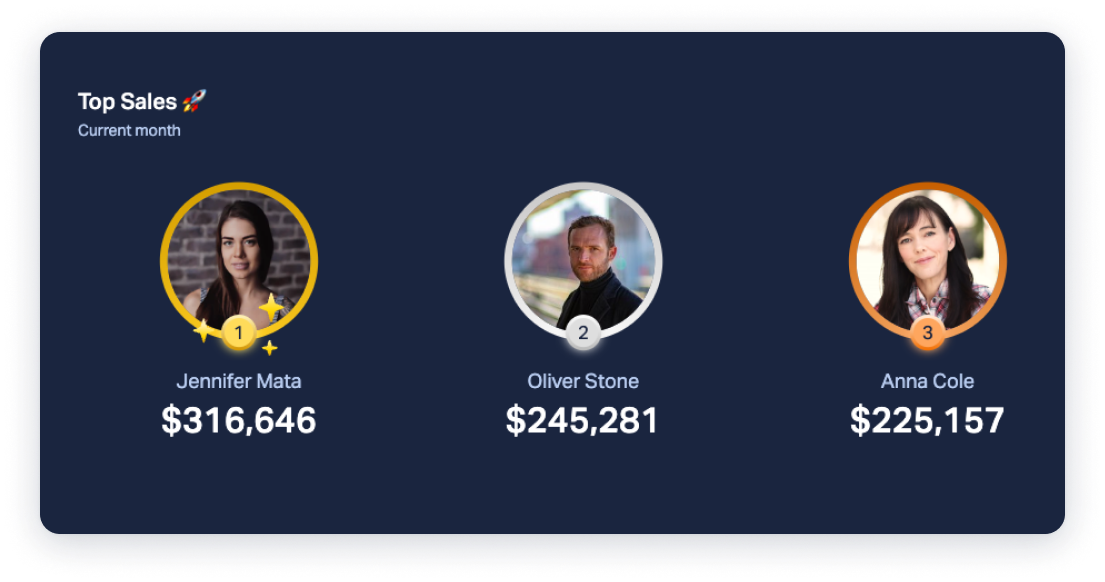
- Live leaderboards: show each rep's progress on the SPIFF metric on a dashboard or an office TV slideshow. See how a sales leaderboard works.
- Contests: set a KPI formula, a target, a duration and prizes for a player or team contest. Milestone contests let every rep who reaches a tier earn the prize, which fits SPIFFs that reward most of the team.
- Notifications: celebrate a won deal or a hit milestone automatically on screens or in chat tools such as Slack or Microsoft Teams.
- Achievements: give a badge when a rep reaches the SPIFF goal, manually or automatically.
- Coins and the reward store: contest prizes can be coins that reps redeem in the reward store for rewards you choose, so you do not need a separate payout process for non-cash prizes.
Plecto does not calculate payroll or tax, so cash SPIFFs still go through your payroll. For a real example of dashboards used around commissions, see how HVAC teams use Plecto for accurate commission tracking. For the wider picture, read about sales gamification.
Conclusion: use a SPIFF sparingly and measure it
A SPIFF is a sharp, short-lived tool for one goal, not a replacement for a good commission plan. Pick a clear target, set a budget below the value of the result, make progress visible and compare against a baseline afterwards. To make the progress visible, see how Plecto contests work.
Questions
SPIFF FAQs
SPIFF most commonly stands for Sales Performance Incentive Fund. Some sources give Sales Program Incentive Fund or Sales Promotion Incentive Fund instead, and the exact origin of the word is disputed. In practice the acronym matters less than the meaning: a short-term incentive paid for a specific sales result.
In sales, a SPIFF is a short-term incentive paid on top of salary and commission for a specific result, such as selling a new product, booking meetings or clearing old stock. It has a clear goal, a deadline and a set reward, so it directs effort to what matters this month.
No. Commission is an ongoing part of the pay plan, usually a percentage of revenue on every sale. A SPIFF is temporary and tied to one goal, such as a particular product or deal type. SPIFFs complement commission and are paid in addition to it.
Base the payout on what the extra result is worth, not on a fixed rule. A SPIFF should cost clearly less than the margin or pipeline value it adds, and it must be large enough to change behavior. Set a total budget cap before launching, and test the size on a small pilot first.
Usually yes. In the US, a SPIFF paid through payroll is typically treated as supplemental wages like bonuses and commissions, and non-cash prizes can be taxable too. Treatment varies by state and by prize type, so confirm the details with your payroll provider or tax advisor before paying out.
Connect your sales data to a live dashboard and show each rep's progress on the SPIFF metric on a leaderboard or contest screen. Plecto does this with real-time dashboards, contests, notifications and a reward store, so reps see where they stand every day instead of at the end.
Start your 14-day free Plecto trial today.
Enjoyed the article? Share it:


