
AI Sales Coaching in 2026: From Reviews to Real-Time Guidance

AI Sales Coaching in 2026: From Reviews to Real-Time Guidance
Delay is the primary problem with sales coaching. A manager can pull a call that happened three days, or even three weeks back, to find a fault, and try to train the rep to improve. In the same way, objection handling can get typed into a shared doc, or conveyed a little too late to the salesperson.
 Build your own
Maybe the client has moved on, and the deal went stale. This is a classic example of the coaching being of quality, but not on time.
AI collapses that number from weeks to seconds. The rep completes a call and gets immediate feedback on what they could have done better.
The Problem with Historical Call Reviews
Most traditional coaching calls focus on the sales that went terribly. Managers rarely review:
-
The calls that go really well, where a lot of the transferable behavior lives. These calls could be example-setters of an ideal call.
-
The calls go well enough but could improve and never get reviewed.
There's also the question of memory. If you get on a sales training call two weeks after the deal has been closed or forfeited, the sales rep you’re speaking to probably has a different version of the deal in their head.
They’ll likely remember many of the details differently, so assume a disconnect between what you want to work with them on, and what they think you should be focusing on.

Modern solutions like CRMs or even call analytics do implement a few measures that help, like tagging, stage tracking, and talk time ratios, but this is still slower than the sales cycles that they were meant to improve.
What AI Coaching Tools Detect
The first thing AI coaching tools do is gather significant context relevant to the client and sales rep in question. There's usually an email thread as well as details on the company that were filled in the demo form to consider.
This helps the system understand how well the sales methodology would work on the said client and company. The sales rep usually has to focus on a few key points, like details on the company, or a client need mentioned in their form. AI coaching tools take these pointers and lay them out very clearly for the reps to review
AI coaching tools also focus on patterns common to every sales rep.
Maybe a rep talks about the budget in 30% of the first calls, but 90% of the second calls, meaning they're stalling that deal until the next meeting.
Maybe there are specific details that the reps get wrong. AI can also spot the talking patterns that convert, or the deals that go through, as ones where the reps let the clients do most of the talking, or broach the topic in certain ways.
These findings become very obvious because AI can look over a lot of sales calls to gather these insights. This is much more difficult to do when a single manager is reviewing a very low number of sales calls involving different reps.
McKinsey's work on generative AI confirms an uptick in productivity from using AI for drafting and summarising.
Coaching Plans Built per Rep
The problem with generic plans is that the generic sales rep does not exist. We're assuming a hypothetical sales rep who is simply average at every sales function—hat they run average discovery and are average at negotiation, but this is rarely the case.
Usually, someone runs a beautiful discovery but is terrible at negotiation. Someone closes hard, but they skip out on upselling. Someone is sporadically great, and occasionally disastrous.
An objection-handling workshop would not really help any of the people described above.
Greg McRoberts, Founder and CMO of Verde Fulfillment USA, is a third-party logistics provider that runs order fulfillment, warehousing, and shipping for e-commerce and B2B brands across its US and Canadian facilities.
He says, “In fulfillment, no two accounts fail the same way. One client has a packaging damage problem and another keeps missing carrier cut-off times. We ran team-wide training for years and the fixes never transferred, because the person who needed them was rarely the person the session was built for.
“Now each account manager gets the two or three things going wrong on their own accounts, reviewed against where they were last month. It is far less impressive than a full-day workshop, but it moves the numbers a lot more.”
Therefore, the only coaching plan that works is one specifically customized for each sales rep. Such a plan identifies key behaviours and tracks them against only that rep’s baseline. As the rep’s behaviour changes, so does the coaching plan.
Real-Time Guidance During Live Calls
So far, we've talked about how an AI sales coach can help after the call, but what really changes coaching is how AI can help during the call.
How does this work?
Maybe the rep is on the call, and the prospect mentions that their contract renews in Q1.
With an AI sales coach, a prompt would surface in the corner of the screen, recommending that the sales rep ask when the evaluation window would open. That nudge reminds the rep of important context that they may not remember in the moment, and guides them into steering the conversation in a favourable direction.
This could go wrong. Some people respond well to being prompted in real time, and some don't. There could be instances of the reps reading the prompts awkwardly, making the use of these nudges obvious to the prospect.
 Build your own
The fix would be to send fewer prompts and only for very, very important items on the agenda. For example, missing a budget question is recoverable, but failing to identify that the person on the call has no signing authority is a little more important and warrants sending a prompt.
There are also coaching hypotheses that can be tested with an AI sales coach. Maybe there's a certain change that you think will help your team. You could just test that in the form of a prompt across the team to see if it works or not.
Gamification and Real-Time Performance Data
The main advantage of quick feedback is that it arrives while reps still care.

Gamification tools like Plecto know this. That's why they put the number where the rep can see it, encouraging the right behaviours without a big speech about accountability.
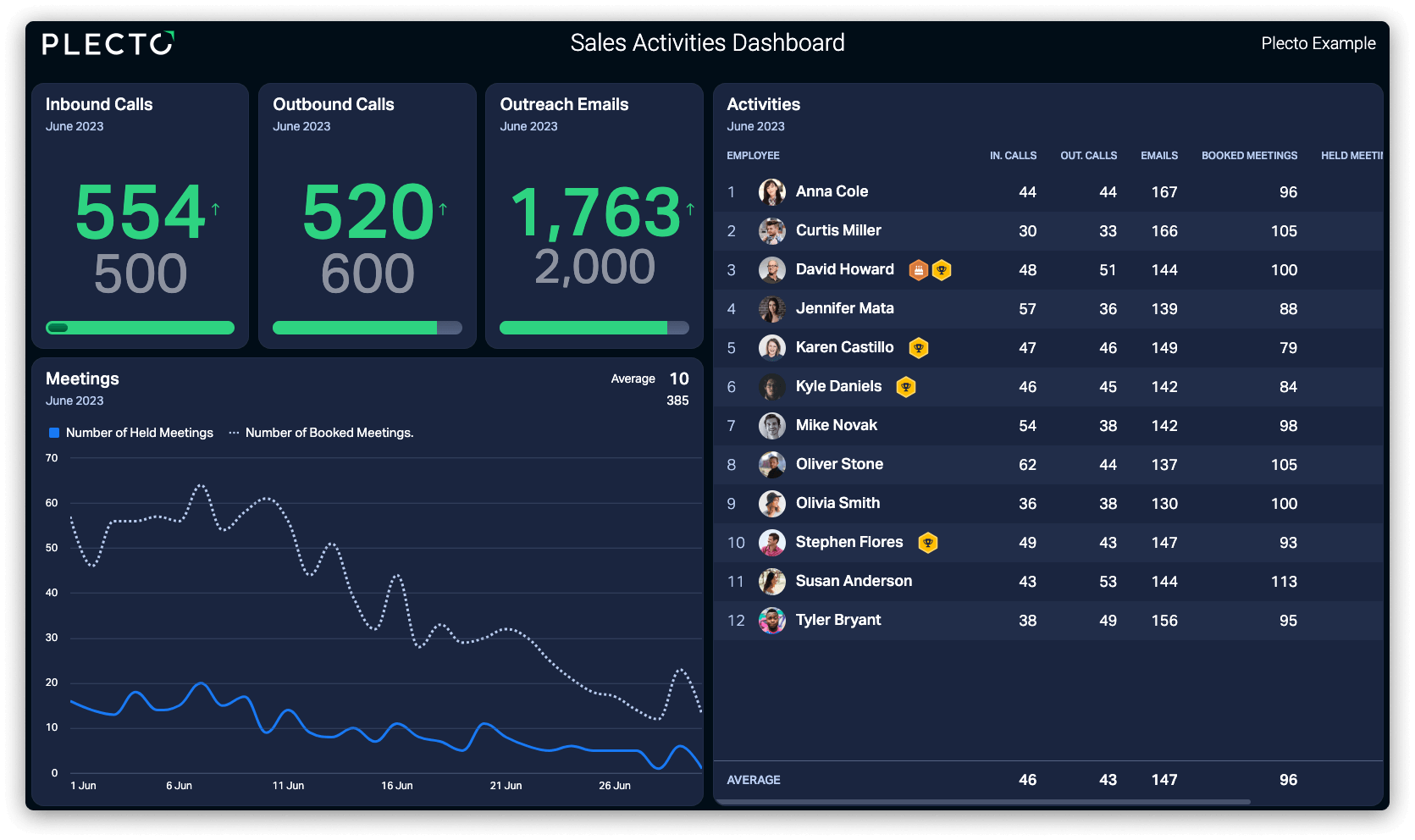
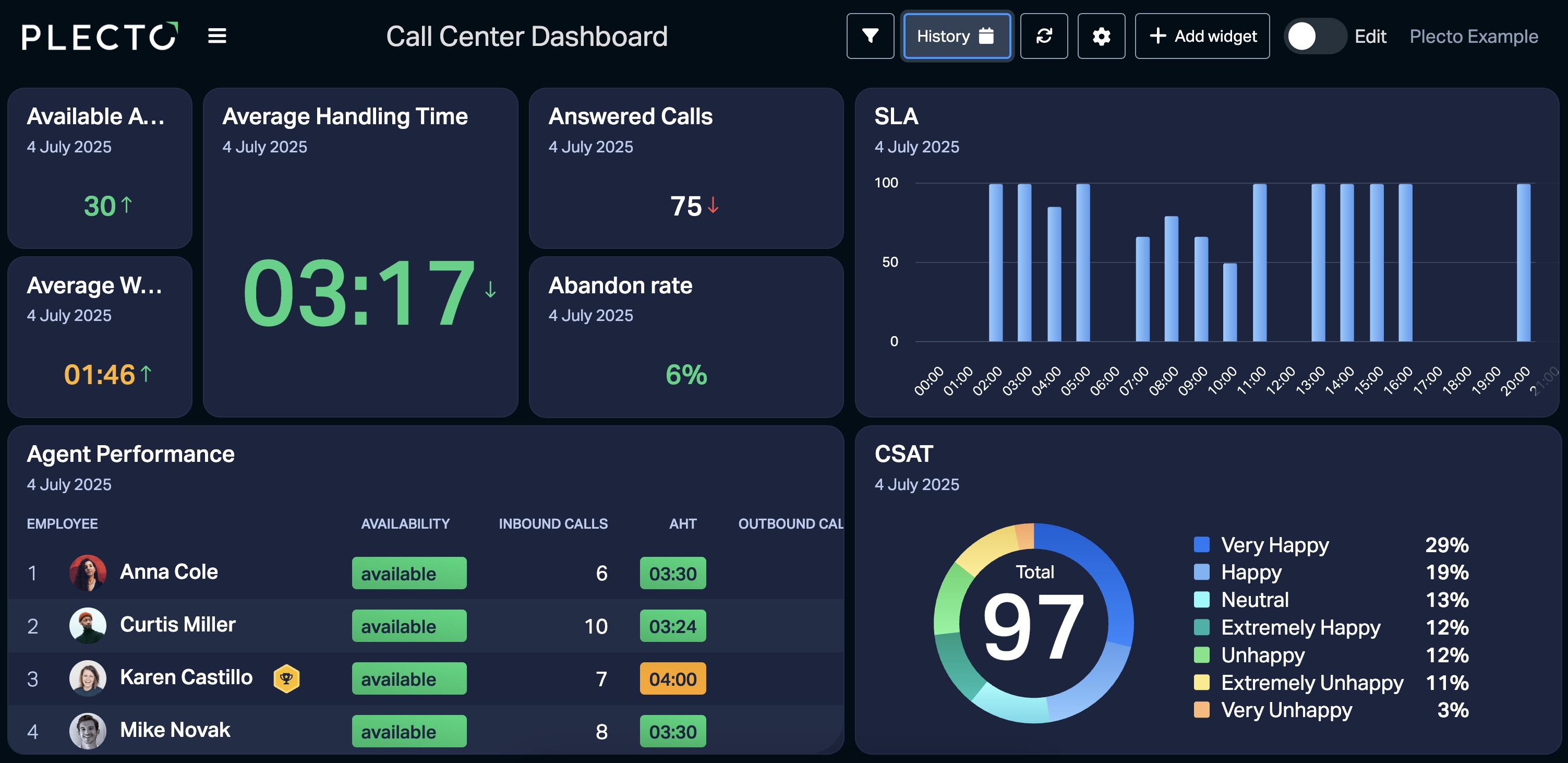
Plecto pulls activity data from the CRM and phone system into live dashboards, so reps can check calls made or next steps booked against their target whenever they want.
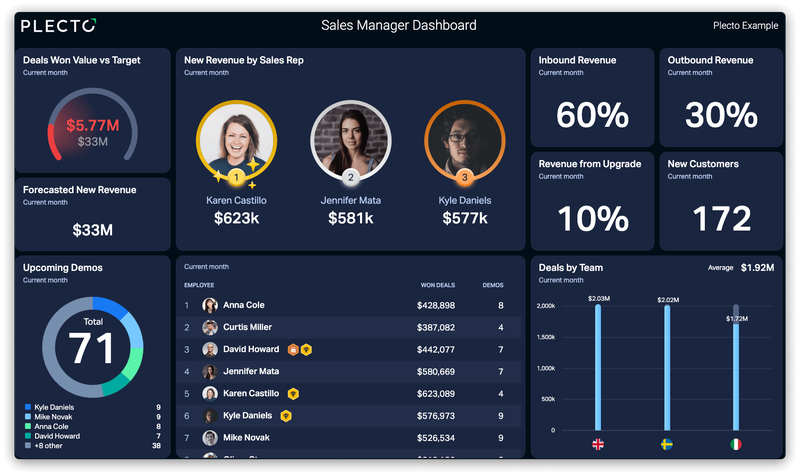
Leaderboards rank the team on those same behaviours and can run on office TV screens, which keeps everyone's progress visible. Contests set a team target with a deadline and show each rep's position as a space race or mountain climb.
When a rep hits a milestone, an instant notification plays on screen with a video, sound, or GIF they've picked, and teams can connect it to Sonos speakers and Philips Hue lights.
Achievements add a badge next to the rep's name, either automatically when they reach a set goal or when a manager awards one. Reps also earn virtual coins for completed tasks and trade them for real prizes in the Reward Store.
We keep stressing behaviours because it's a much better KPI than an outcome. An outcome can hinge on several factors, but your rep has full control over their sales behaviours.
Data Privacy and Ethics
Recording, storing, and analyzing every customer conversation means holding the ones where a prospect mentions a layoff, a health issue, or their own frustration with their boss.
That is a serious obligation, and treating it as an IT checkbox is how teams end up in a bad conversation with legal.
Lucy Rendler-Kaplan is PR Manager at Thyseed, a baby feeding brand that sells bottles, warmers, and sterilisers directly to parents.
She says, “Parents tell our support team things they would not put in an email like a baby who is not gaining weight or a feeding problem they have been crying about at 3 AM.
“We decided early that the recording gets used to help that parent and to coach the person who took the call, and nothing else. No marketing list and no pulling clips for a slide. If you cannot say out loud what a recording will be used for, you should not be keeping it.”
Consent needs to be explicit and stated on the call, not buried in a footer:
-
Retention windows need to be short and enforced.
-
Access needs to be scoped, because there is rarely a good reason for a sales ops analyst to pull transcripts of a rep's performance conversations.
For anyone selling into the EU, the lawful basis and transparency requirements under GDPR apply here whether or not the sales team has thought about it. The NIST AI Risk Management Framework is a reasonable structure for working through the rest.
There is a second obligation that gets less attention. Harvard Business Review has argued that AI in selling works when it augments the human but degrades quickly when it is asked to replace judgment.

A model can report that a rep’s discovery scores dropped for three weeks. It cannot report that the rep’s father is in the hospital. Any AI system that scores people needs a manager willing to overrule it, and a culture where doing so is normal.
How to Roll Out AI Coaching
Small, specific, and boring beats a platform-wide rollout every time.
-
Pick two behaviors. Pilot with one team that already trusts its manager, because the pilot is a trust test before it is a technology test.
-
Set consent and data-handling rules on day one, in writing, and tell reps what is stored and for how long.
-
Put the AI’s read of a call next to the manager’s read in the 1:1. When they disagree, discuss it openly. That is what builds credibility.
-
Train the coaches before the reps.
The teams that struggle are usually the ones that bought the platform first and then decided what to measure afterward.
Clutch's AI maturity research puts numbers on how uneven that groundwork is. Across 600 small businesses already using AI, only 54% say their data is clean and centralised, only 54% have a formal AI strategy, and the same share actually measures what their AI tools deliver. A coaching tool sitting on top of a CRM nobody maintains inherits all three of those gaps on day one.
 Build your own
Clean CRM data—and a manager who knows what good looks like—are still the inputs. AI only makes them faster.
What Comes After 2026
AI coaching will eventually include product usage and support signals in your coaching stream to track customer behaviours way after the deal has been closed. For now, we can build simulations from our own lost calls with the real competitor objections and buyer personas.
Plecto supports that rollout with live dashboards that show each rep's activity against target, One-on-ones that keep a log of every coaching conversation, and gamification features that recognise the behaviours managers want repeated.
Start a 14-day free trial or book a demo to test it with your first team.
Start your 14-day free Plecto trial today.
Enjoyed the article? Share it:


BROOKE WEBBER