 Sign in

Call Center Agent Burnout: Causes, Symptoms, and Solutions
Call center agent burnout drives turnover. Learn the WHO definition, the warning signs, the root causes and how recognition and coaching reduce agent stress.
Call center agent burnout is now the norm, not the exception. In Salesforce's State of Service report (6th edition, 2024), over half of service agents say they have experienced burnout, and 77 percent report bigger and more complex workloads. Turnover follows close behind: 69 percent of service decision makers call agent attrition a major or moderate challenge. This is not just a scheduling issue. It is a structural problem tied to invisible daily effort and chronic stress.
Burnout is expensive. Every agent who leaves costs recruitment, onboarding and lost customer trust. When experienced agents go, queue times spike, and the remaining staff absorb the extra volume, which speeds up their own exhaustion. Breaking this cycle means understanding the root causes of workplace stress and putting systems in place that recognize daily effort. If attrition is already high, our guide to reducing call center turnover covers how to measure it.
What is call center agent burnout?
The World Health Organization (WHO) includes burnout in the ICD-11 as an occupational phenomenon. In the WHO's words, "it is not classified as a medical condition". It defines burnout as "a syndrome conceptualized as resulting from chronic workplace stress that has not been successfully managed".
Burnout is not the same as being tired after a long shift. Fatigue goes away with a weekend of rest; burnout persists. The WHO describes three dimensions:
- Feelings of energy depletion or exhaustion
- Increased mental distance from one's job, or feelings of negativism or cynicism related to one's job
- Reduced professional efficacy
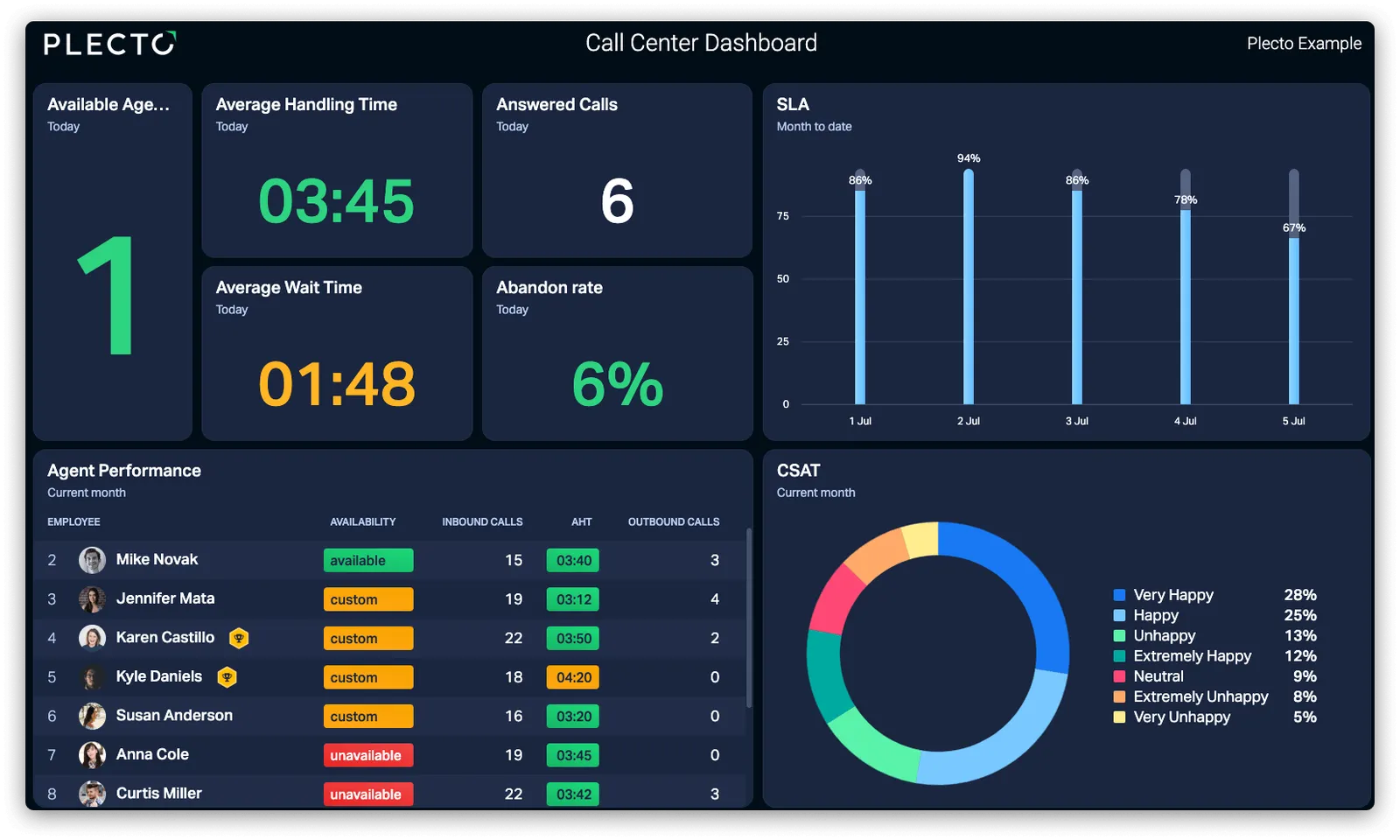
When agents reach this stage, their performance drops. They take longer to resolve tickets and transfer calls more often. Tracking these shifts on live call center dashboards helps managers spot the early warning signs before an agent hands in their notice.
The three categories of call center agent burnout symptoms
Managers often miss the signs of call center agent burnout because they only look for obvious frustration. The symptoms fall into three categories that affect the emotions, the mind and the body.
Emotional signs of call center agent burnout
Customer service is intense emotional labor, a term sociologist Arlie Hochschild introduced in The Managed Heart (1983). Agents experience emotional dissonance: the conflict between what they feel and the emotions they must show customers. Research on emotion work links that dissonance to exhaustion. An agent must sound cheerful and empathetic even when a caller is shouting at them. Suppressing genuine emotions for eight hours a day leads to cynicism, irritability and a detached attitude toward customers.
Cognitive signs of call center agent burnout
Chronic stress impairs concentration. Agents with cognitive burnout struggle with decision fatigue. They forget procedures they have known for years and find it hard to focus on complex tickets, which leads to data entry errors or wrong troubleshooting steps. If a veteran agent's quality assurance scores suddenly drop, cognitive exhaustion is a likely culprit.
Physical signs of call center agent burnout
A 2020 Cornell ILR and McMaster study of about 2,100 unionized US call center workers found high stress across a range of measures, including emotional strain, sleep difficulties, use of anxiety medication and repetitive stress injuries. Agents can also experience acoustic shock from sudden loud sounds through their headsets, and many carry muscle tension in the neck and back. Absenteeism is a lagging indicator of call center agent burnout: by the time sick days climb, the damage is done.
Core causes of call center agent burnout
Understanding the symptoms is only the first step. To fix the problem, leadership must address the conditions that create chronic stress.
How electronic performance monitoring fuels call center agent burnout
Call centers are highly measured environments. Electronic performance monitoring tracks every second of an agent's day, from average handle time to breaks. Tracking call center KPIs is necessary to run the operation, but weaponizing the data creates anxiety. A meta-analysis of 70 samples found that electronic monitoring is linked to higher stress and lower job satisfaction. When agents feel watched rather than supported, stress multiplies.
The job demands-control model
Researchers use Robert Karasek's job demands-control model to explain workplace stress. It holds that strain is highest when a job combines heavy demands with little control. Call center agents face heavy demands from angry customers and strict targets, with almost no control over their workflow, the calls they receive or the scripts they must read. That combination is a recipe for rapid exhaustion.
Role ambiguity and lack of skill variety
Agents burn out when they do not understand what success looks like. Role ambiguity sets in when management changes targets often without explaining why. A lack of skill variety makes the job monotonous on top of that: answering the same password reset question fifty times a day offers no stimulation, which speeds up mental disengagement.
Control vs. involvement: how HR design drives call center agent burnout
How a company organizes its people has a direct effect on call center agent burnout. Many traditional contact centers are control-oriented. They prioritize strict adherence to rules, heavy monitoring and penalties for missed targets, and treat agents as interchangeable.
Involvement-oriented centers take the opposite approach. They invest in training, autonomy and employee participation. Research by Rosemary Batt and Alexander Colvin on call centers found that high-involvement work practices and long-term investment in employees go with lower quit and dismissal rates. In practice, involvement starts with giving agents visibility into their own performance data so they can self-correct. When agents understand how their work affects the wider business, they feel ownership rather than oppression.
Fighting call center agent burnout with real-time recognition
Agent turnover is closely tied to invisible daily effort. Agents handle back-to-back difficult calls, de-escalate angry customers and juggle complex software, yet that effort often goes unnoticed. The only time many agents hear from a supervisor is when a metric drops.
Celebrating micro-wins reverses that pattern. Instant recognition validates the invisible effort and gives a moment of positive feedback to offset a tough call. When a difficult ticket finally closes, the system should acknowledge it right away.
Notifications and call center gamification turn a grinding shift into a series of achievable goals. In Plecto, a notification can play a sound and an animation on the office screens when an agent hits a daily target. For remote teams, the same notification can post a message in Slack or Microsoft Teams. A short note in the team channel saying an agent just saved a high-risk account lifts morale instantly, and shows the team that leadership sees their work.

Plecto connects to 150 systems, including telephony and helpdesk tools, so these celebrations trigger from live data without any manual input from managers. See the full list of integrations.
Practical steps to reduce call center agent burnout
Technology and recognition are powerful, but they work only alongside strong management practices. For more ideas, see our tips to motivate call center agents.
Shift from surveillance to structured coaching
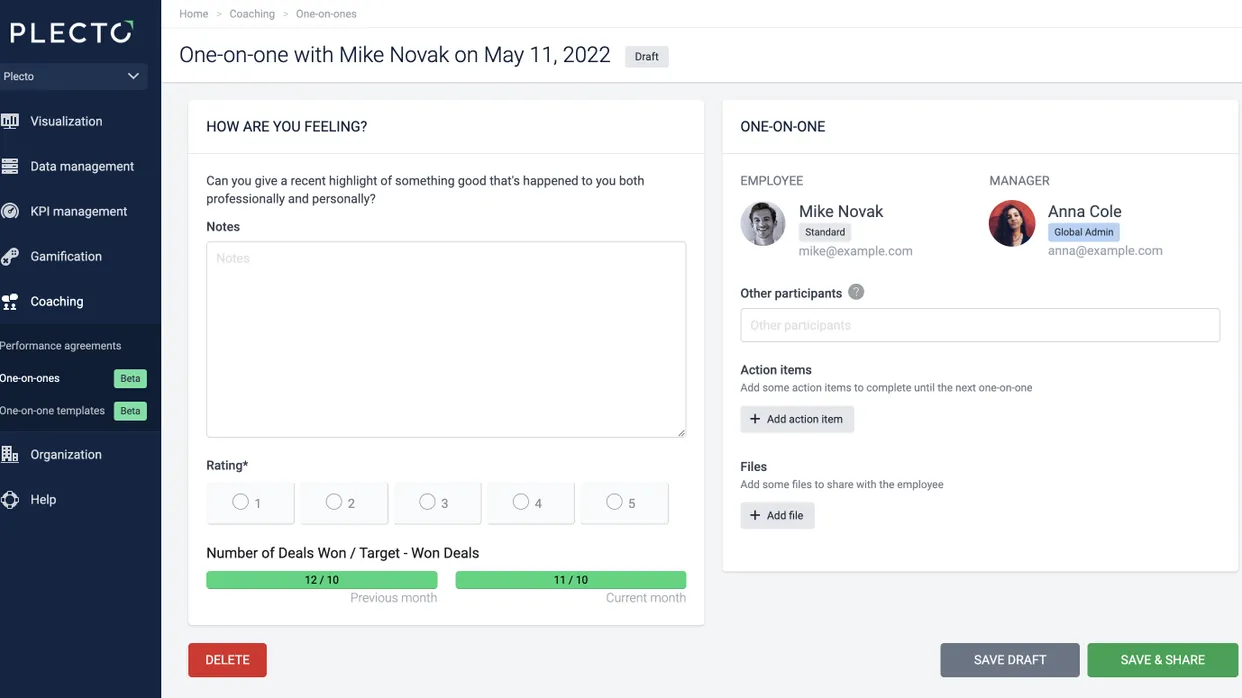
Stop using data to punish and start using it to coach. Regular one-on-ones give agents a safe space to raise frustrations before they quit. With structured coaching tools, managers and agents can set performance agreements together. That gives the agent a voice in their own development and directly addresses the lack of control described by the job demands-control model.
Display data openly and fairly
Isolation is a major factor in burnout, especially for remote agents. Shared goals build camaraderie. Use slideshows on office TVs or desktop monitors to show team progress, so everyone sees the same numbers and nobody has to guess how the department is doing. Remote agents can follow the same goals in the mobile app, so they never feel cut off from the team.
Automate reporting to reduce manager burnout
Managers cannot support their agents if they are burned out too. Hours spent compiling spreadsheets keep supervisors from talking to their team. Automated reports free up that time for people. Managers can also use the AI Formula Assistant to build custom metrics that track workload, such as complex tickets handled per agent.
Conclusion: call center agent burnout is a structural problem
Call center agent burnout is a structural issue, not a personal failure. Shift from strict monitoring to real-time recognition, give your agents more control over their work and celebrate the small wins every day. Start a free trial to see how transparent data and instant recognition can lift your team's morale.
Questions
Frequently asked questions about call center agent burnout
It depends on how severe the exhaustion is. Mild fatigue might pass after a week of vacation. Severe burnout can take months of reduced workload, a change of role or professional support to overcome. Prevention is always cheaper and more effective than recovery.
Emotional dissonance is the strain of hiding your true feelings to display the emotions your job requires. In a call center, it usually means suppressing frustration or anger to keep a cheerful, professional tone with a difficult customer. Over time, this drains the agent's energy.
It can help. Gamification adds immediate positive feedback to a job that is often full of negative customer interactions. Earning Coins, unlocking achievements or competing in friendly contests gives agents short-term goals, breaks up the monotony of a shift and provides the recognition that keeps morale up.
Watch for behavioral changes in your data: sudden spikes in average handle time, longer wrap-up time or a drop in total calls taken. Connect your phone system and helpdesk through data sources and the API to build a dashboard that flags these warning signs automatically.
Start your 14-day free Plecto trial today.
Enjoyed the article? Share it:


