 Sign in

Free tool
Sales commission calculator
Model what each rep earns under a flat, tiered, accelerator or draw commission plan, then roll it up to see what the plan costs for your whole sales team.
Discover Plecto's Sales Commission Calculator
A fixed percentage on every dollar of revenue — simple and predictable.
Guaranteed pay per rep, before any commission.
Revenue an average rep closes in the commission period.
Used to roll a single rep's plan up to the whole team.
Paid on every dollar of revenue.
A flat 10% on all revenue closed.
Total compensation breakdown
Illustrative comp modelling — build and automate your exact plan in Plecto.
Assumes revenue and base salary cover the same period; figures are estimates.
How to use the sales commission calculator
A sales commission calculator shows how much a sales rep earns in commission for the revenue they close, and what their total pay comes to with base salary added. Pick a commission structure, enter base salary, revenue per rep and team size, and the calculator returns commission per rep, total compensation, the effective commission rate and the cost for the whole team.
- Choose a commission structure: flat rate, tiered, accelerator or draw.
- Enter the base salary each rep is paid before commission.
- Enter revenue per rep for the same period as the base salary, usually a year.
- Set the number of reps to see the total cost of the plan.
- Fill in the plan details: a single rate, tier brackets, a quota or a monthly draw.
Switch the currency between USD, EUR, GBP and DKK. All figures are estimates for planning; your actual plan rules, clawbacks and payout timing decide what reps are paid.
How to calculate sales commission
The basic formula, and how to find the right commission rate.
Sales commission = Revenue closed × Commission rate
A rep who closes $500,000 in revenue on a 10% flat commission earns $500,000 × 0.10 = $50,000 in commission. With a $60,000 base salary, total compensation is $110,000.
To set the commission rate, start from what you want a rep to earn at target and work backwards:
Commission rate = Target variable pay ÷ Quota
If on-target variable pay is $60,000 and the annual quota is $600,000, the commission rate is $60,000 ÷ $600,000 = 10%. Use the sales commission calculator to test the result at 50%, 100% and 150% of quota before you roll the plan out.
Sales commission structures explained
The four plans in the calculator, each with a worked example.
Commission-only (straight commission)
Reps earn no base salary, only commission. It is common in high-volume or independent sales roles. To model it, set the base salary in the sales commission calculator to 0 and use any of the plans below.
Flat-rate commission
Every dollar of revenue earns the same percentage. Simple to explain and easy for reps to check.
Example: $500,000 × 10% = $50,000 commission.
Tiered commission
Higher rates apply as revenue passes each bracket. The rate is marginal: it applies only to the revenue inside that tier, like tax brackets.
Example: 8% up to $150,000, 10% from $150,000 to $350,000, and 12% above. On $400,000 of revenue:
- $150,000 × 8% = $12,000
- $200,000 × 10% = $20,000
- $50,000 × 12% = $6,000
- Total commission: $38,000, an effective rate of 9.5%
Commission with accelerators
A base rate applies up to quota, and a multiplier lifts the rate for revenue above it. In the sales commission calculator, the rate rises to 1.5× the base between 100% and 150% of quota, and to 2× above 150%.
Example: 8% base rate, $400,000 quota, $500,000 closed (125% of quota):
- $400,000 × 8% = $32,000
- $100,000 × 12% (1.5 × 8%) = $12,000
- Total commission: $44,000
Draw against commission
The rep receives a guaranteed monthly draw, which is an advance on future commission. If earned commission is higher than the draws paid, the rep keeps the surplus.
Example: 10% commission and a $3,000 monthly draw ($36,000 a year).
- At $500,000 revenue, earned commission is $50,000: the rep keeps $14,000 above the draw.
- At $300,000 revenue, earned commission is $30,000, which is $6,000 short of the draw. With a recoverable draw, the $6,000 carries forward and is repaid from future commission. With a non-recoverable draw, the rep keeps the full $36,000 and the shortfall is written off.
Which sales commission structure should you choose?
| Structure | Best for | Watch out for |
|---|---|---|
| Flat rate | Simple sales cycles, new teams, transactional deals | No extra pull to exceed target |
| Tiered | Rewarding reps who push past set revenue levels | Reps holding deals back to land them in a higher tier next period |
| Accelerator | Quota-carrying B2B teams with predictable targets | Unrealistic quotas make the accelerator feel out of reach |
| Draw | New hires ramping up, long sales cycles, seasonal sales | Recoverable deficits can pile up and demotivate |
For short pushes on one product or behavior, add a SPIFF on top of the plan instead of changing commission rates. Whatever the structure, reps should be able to see where they stand against their targets every day. When reps can't see their commission until payday, the plan stops changing behavior. Read more about sales KPIs to track, such as average deal size and win rate.
Show live commission on every rep's dashboard
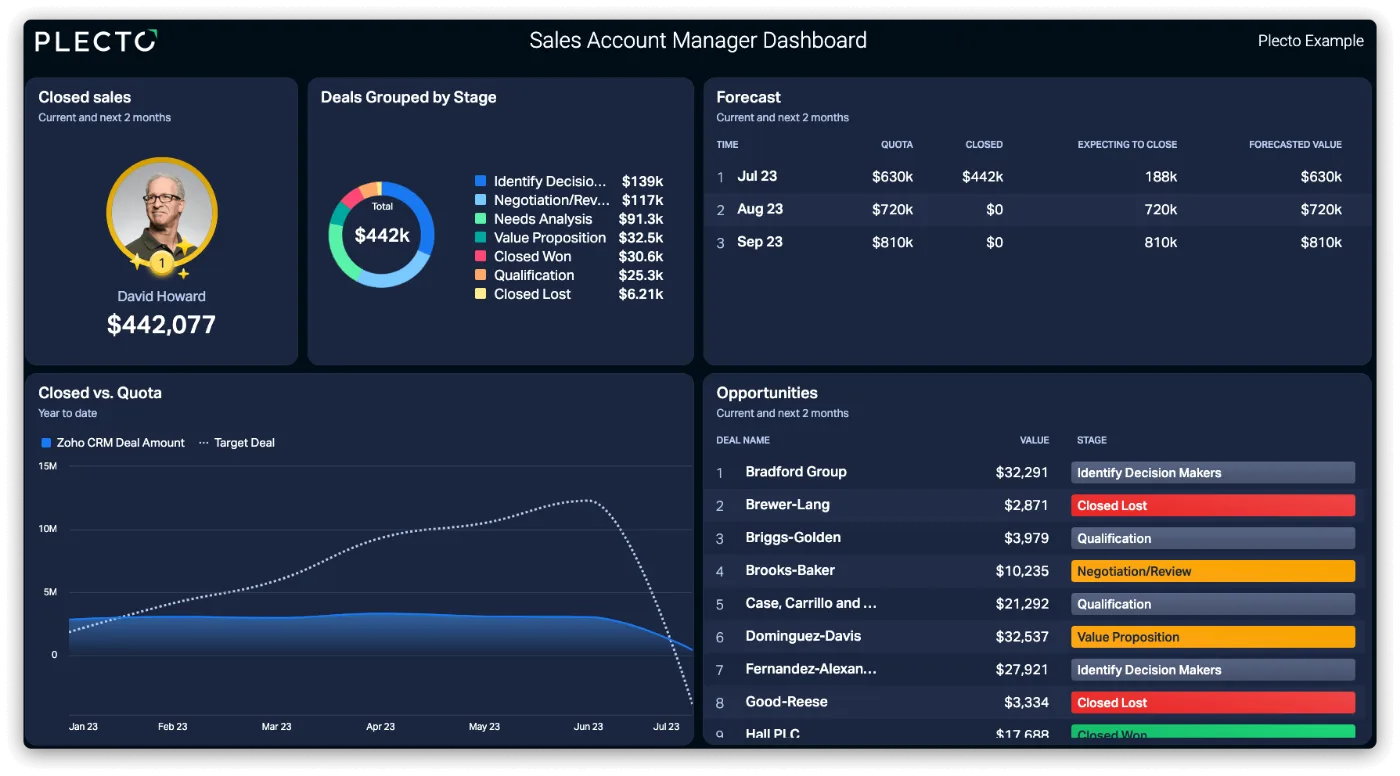
A spreadsheet tells reps what they earned last month. Plecto shows it as it happens. Plecto connects to your CRM through 150+ integrations and uses formulas to calculate commission on every closed deal, including tiered rates.
- Build commission formulas with different rates per deal size or target, without IF statements (see the formula guide)
- Show each rep their own commission and progress on sales dashboards and in the mobile app
- Agree individual targets with performance agreements and add sales contests on top
See how HVAC teams automate commission tracking with Plecto dashboards.
Frequently askedquestions
Multiply the revenue a rep closed by their commission rate. A rep who closes $200,000 on an 8% plan earns $16,000. For tiered plans, apply each rate only to the revenue inside its bracket and add the results.
Multiply the sale amount by 0.02. On a $25,000 sale, a 2% commission is $25,000 × 0.02 = $500. The same works for any rate: divide the percentage by 100 and multiply.
There is no single typical rate: it depends on your margins, deal size and how much of a rep's pay is variable. A practical way to set it is to divide on-target variable pay by quota. A rep with $60,000 in target commission and a $600,000 quota needs a 10% rate.
A tiered commission structure pays a higher rate as a rep's revenue passes set thresholds, for example 8% up to $150,000 and 10% above it. Each rate usually applies only to the revenue within its tier.
An accelerator is a higher commission rate that applies once a rep passes quota. It rewards overperformance: a rep on an 8% base rate might earn 12% on revenue between 100% and 150% of quota.
A draw is a regular payment advanced against future commission. If the rep earns more commission than the draws paid, they keep the difference. With a recoverable draw any shortfall is repaid later; with a non-recoverable draw it is not.
Revenue-based commission is simpler and is what this sales commission calculator uses. Gross-profit-based commission protects margins when reps can discount, because the rep earns less on deals sold at a lower price. Choose the base your reps can see and influence.
The effective commission rate is total commission divided by total revenue. On tiered and accelerator plans it sits between the lowest and highest rates, and shows what the plan actually pays per dollar sold.